Selling a SaaS company in Cyprus, or exiting a high-growth AI-led enterprise, is a structural outcome rather than a closing-day decision. In the 2026 regulatory environment, a tax-efficient realization of capital is the result of a “Substance-First” architecture built across four distinct layers:
-
Shareholding architecture
-
IP positioning
-
Tax residency
-
Economic substance
This is the Exit Integrity Threshold. A Cyprus tech exit qualifies for 0% tax only when legal form, asset composition, and substance align under audit conditions. For founders, this process begins years earlier at the stage of Cyprus Company Formation, ensuring the structure is “exit-ready” from day one.
1. The Share Sale Standard (2026)
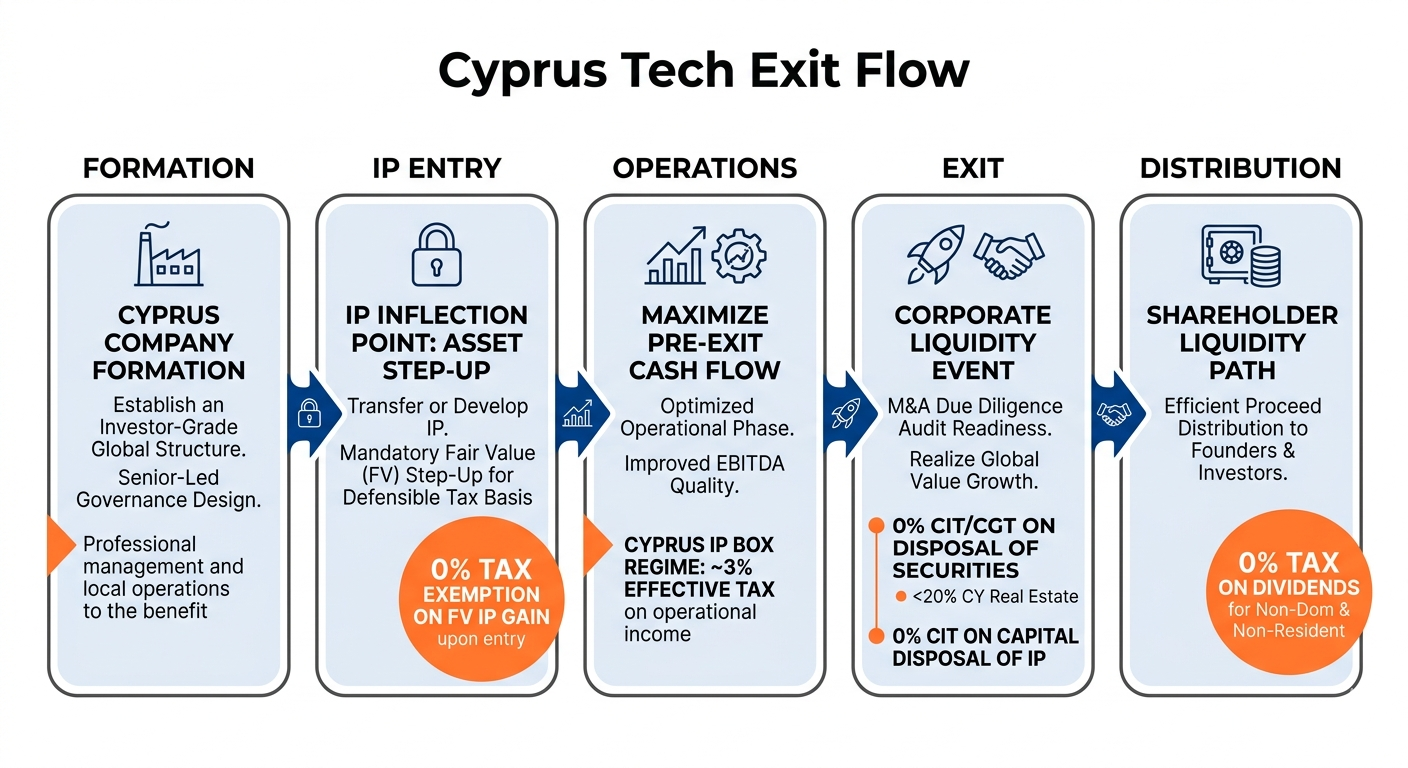
The primary and most defensible path for selling a SaaS company in Cyprus is a share sale. A share sale is the standard method for selling a SaaS company in Cyprus because it qualifies for a 0% tax exemption under specific conditions. Under the 2026 framework (effective 1 January 2026), the tax treatment remains globally competitive:
-
Corporate Income Tax (CIT): Gains on share disposals are Exempt.
-
Capital Gains Tax (CGT): 0%, subject to the real estate threshold.
The 20% Real Estate Exposure Test
This threshold was tightened in 2026 and serves as a primary diligence checkpoint.
2. Why Cyprus is the Global Hub for Tech Liquidity
Cyprus remains a premier jurisdiction for technology exits due to a convergence of robust fiscal incentives:
-
0% Tax on Share Disposals: Comprehensive exemption for the sale of titles.
-
0% Capital Gains Tax on IP: Profits from the disposal of Intellectual Property (IP) of a capital nature are generally exempt from tax.
-
Effective 3% Rate: Operational income optimized under the Cyprus IP Box Regime which provides an effective 3% tax rate on qualifying profits.
-
Zero Withholding Tax: No tax on outbound dividends to non-resident or Cyprus Non-Dom Residency shareholders.
-
Regulatory Alignment: Full compliance with EU Tax Directives and OECD Pillar Two standards.
Cyprus is not competitive because of one tax rule. It is competitive because multiple tax, legal and regulatory advantages align into a single structure.
3. Asset Sales and the Capital Nature Test
While share deals are the standard, some buyers request the direct acquisition of IP. This introduces a classification test under the 15% Corporate Income Tax regime.
Capital vs. Trading Treatment
The distinction between inventory and capital assets must be defensible under audit conditions.
-
Capital Disposal: Profits from the disposal of IP assets that form part of the company’s permanent capital base are generally exempt from tax.
-
Trading Income: If the disposal is deemed an integral part of recurring commercial activity, it is subject to the 15% CIT.
If the IP is not clearly separated as a capital asset, buyers assume tax risk and may seek aggressive escrow retentions.
4. The IP Inflection Point
The tax outcome of an exit is often determined at the IP Inflection Point — the moment IP enters the jurisdiction. When IP is transferred or developed in Cyprus, its valuation must reflect market reality through a Fair Value (FV) Step-up.
This step also defines the future tax baseline used by both auditors and acquirers. Without this discipline, the audit trail for pre-entry value vs. Cyprus-generated growth becomes obscured, making the capital treatment harder to support.
5. Equity Efficiency: NID and Exit Valuation
The Notional Interest Deduction (NID) directly impacts how buyers assess financial quality. NID allows new equity (including IP contributed at Fair Value) to generate a deemed interest deduction of up to 80% of taxable profits.
In practice, buyers rely on the higher cash retention the NID creates. By improving EBITDA quality and cash conversion, the NID strengthens the financial metrics used to calculate the final exit multiple.
6. Substance and the ATAD 3/Pillar Two Risk
A Cyprus structure must demonstrate real economic activity to withstand international scrutiny. This is the Substance Trigger Event. Under EU ATAD 3 (Unshell Directive) and OECD guidelines, buyers assess:
-
Authority: Where strategic decisions are made and if directors have real authority.
-
Control: Whether the company genuinely controls its IP assets.
-
Operations: Whether the local infrastructure matches the revenue scale.
In 2026, substance reviews are often conducted before financial due diligence is finalized. Structures without this level of substance are increasingly rejected during institutional due diligence. Examples of how it works in practice can be found in our Cyprus IP Holding Company Structure article.
2026 Tech Exit Comparison Matrix
The Tech Exit Ecosystem
To meet the Exit Integrity Threshold, founders should review our supporting frameworks:
-
The Founder’s Guide to Cyprus IP Box (2026 Update) – How to calculate your nexus fraction before the exit.
-
Governance & Substance Protocol – Protecting your 0% status against ATAD 3 audits.
-
The Non-Dom Liquidity Roadmap – Personal tax optimization for the post-exit phase.
FAQ: Selling a SaaS Company in Cyprus
Is a share sale always tax-free in Cyprus? Yes, provided the company does not exceed the 20% real estate exposure threshold. For most AI and SaaS companies, this is the default exit path.
Do buyers prefer share sales or asset sales in Cyprus? Buyers generally prefer share sales due to greater tax certainty and reduced reclassification risk under EU frameworks.
Can software or IP be sold tax-free? Yes, if the disposal is of a capital nature. If treated as trading income, it is subject to the 15% CIT.
What is a Fair Value Step-up? It is the recognition of IP at market value upon entry into Cyprus, creating a defensible tax base and supporting future NID claims.
Does NID reduce tax before exit? Yes. It can reduce taxable profits by up to 80%, maximizing cash flow and financial metrics in the years leading to the sale.
How does ATAD 3 affect an exit? If a company lacks substance, it may be classified as a “shell,” which could jeopardize the 0% exit benefits during buyer due diligence.
A 0% Exit Is Engineered Early
A successful exit is not created during negotiations. Success is the result of Intellectual Property Structuring, Governance Design, and Residency Alignment. If these are correct, the tax outcome follows.
Doviandi advises founders and investors on Cyprus structures designed for audit resilience and investor-grade exits.
Request a structural audit to determine whether your current setup meets the Exit Integrity Threshold before a future transaction.