Category

Articles & Guides

SaaS and AI Company

Cyprus SaaS and AI Company Structure (2026 Operational Framework)

By Articles & Guides No Comments

SaaS and AI Company

Following the January 1, 2026 Cyprus tax reform, which increased the standard corporate tax rate to 15%, Cyprus has increasingly become a jurisdiction considered by SaaS, AI, and digital IP-driven businesses operating internationally.

In practice, however, operating a Cyprus SaaS or AI company involves substantially more than company incorporation or access to the Cyprus IP Box regime.

For founder-led SaaS and AI companies, the position is generally evaluated based on how ownership, governance, development activity, and tax residency operate together over time.

This framework is particularly relevant for:

  • SaaS businesses

  • AI and machine-learning companies

  • API and infrastructure providers

  • Software licensing businesses

  • Remote-first development teams

  • Founder-led intellectual property structures

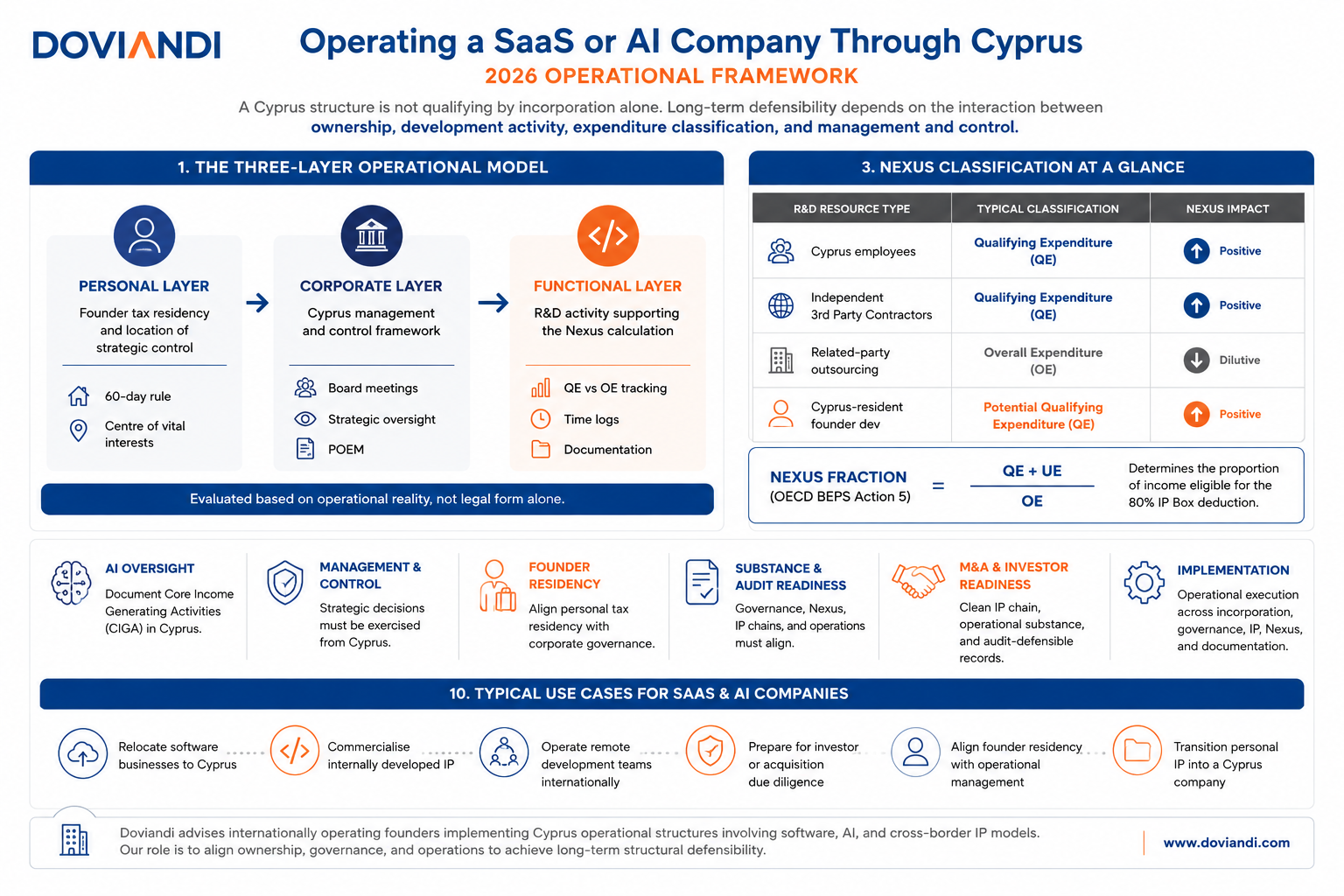
A Cyprus SaaS or AI company does not become qualifying merely because it is incorporated in Cyprus or holds intellectual property formally. Qualification depends on the interaction between ownership, development activity, expenditure classification, and management and control over time.


1. The Three-Layer Operational Model

In practice, SaaS and AI companies operating through Cyprus are typically assessed across three interconnected operational layers.

Layer Operational Focus Typical Review Area
Personal Founder tax residency and location of strategic control 60-day rule; centre of vital interests
Corporate Cyprus management and control framework Board meetings; strategic oversight; POEM
Functional R&D activity supporting the Nexus calculation QE vs OE expenditure tracking

The structure is generally evaluated based on operational reality rather than legal form alone. For a broader overview of how these layers interact within the Cyprus IP Box framework, see our guide on relocating personally held IP to Cyprus.


2. Why SaaS and AI Companies Use Cyprus

Cyprus structures are commonly considered where businesses involve:

  • internally developed software
  • subscription-based SaaS revenue
  • AI model development
  • proprietary algorithms.
  • licensed software infrastructure
  • cross-border digital operations

Under the Cyprus IP Box regime, qualifying companies may access an 80% deduction on qualifying profit derived from qualifying intangible assets.

The framework follows the OECD Modified Nexus Approach under BEPS Action 5, linking the benefit directly to qualifying development activity rather than ownership alone.


3. Remote Development Teams and the Nexus Fraction

Many SaaS and AI businesses operate with developers located across multiple jurisdictions. Under the Cyprus IP Box regime for software and AI companies, the location of the developer is generally less important than:

  • the legal relationship
  • the classification of expenditure
  • the level of operational oversight
  • the structure of the development activity

Typical Nexus Treatment

R&D Resource Type Typical Classification Nexus Impact
Cyprus employees Qualifying Expenditure (QE) Positive
Independent 3rd Party Contractors Qualifying Expenditure (QE) Positive
Related-party outsourcing Overall Expenditure (OE) Dilutive
Cyprus-resident founder dev Potential QE Positive

As a result, contractor structuring and development oversight directly affect the Nexus fraction.

For a technical breakdown of how QE, Overall Expenditure (OE), and Uplift Expenditure (UE) interact, refer to our guide on the Cyprus IP Box Nexus Fraction. You can also model different expenditure scenarios using the Cyprus IP Box Calculator.


4. AI-Specific Operational Considerations

For AI and machine-learning businesses, authorities increasingly distinguish between:

  • ownership of the model
  • execution of development work
  • operational oversight of technical activity.

In practice, operational defensibility may depend on documenting the Core Income Generating Activities (CIGA) connected to the Cyprus company.

This may include:

  • Architectural decision-making

  • Model deployment oversight

  • Inference system optimisation

  • Approval workflows

  • Strategic R&D direction

  • Technical sign-off procedures

Operational documentation often becomes the primary evidence demonstrating alignment between the Cyprus company and the underlying development activity.


5. Management and Control in Practice

For internationally operating SaaS and AI founders, management and control is often one of the most scrutinised aspects of the Cyprus company. Authorities may examine where strategic decisions are made, who exercises operational control, and the location of directors.

A Cyprus company is generally expected to demonstrate that strategic management is exercised from Cyprus rather than merely documented there. Where founder residency and operational activity remain substantially connected to another jurisdiction, Double Tax Treaty tie-breaker rules may become relevant.


6. Founder Relocation and Residency Alignment

For founder-led SaaS and AI businesses, personal tax residency and the Cyprus operating company are often interconnected. In practice, structures may involve relocation under the Cyprus 60-day rule together with local governance frameworks and the relocation of strategic oversight. Where residency positions conflict across jurisdictions, authorities may examine the centre of vital interests and the operational decision-making location.


7. Operational Substance and Audit Readiness

In practice, SaaS and AI companies are generally assessed based on whether the operational profile supports the legal structure.

Area Common Challenge
Governance Strategic decisions exercised outside Cyprus
Nexus Misclassification of related-party expenditure
IP Ownership Incomplete assignment documentation
Operations Disconnect between legal structure and actual conduct

For a worked numerical example of how the Nexus calculation operates in practice, see our detailed calculation example.


8. M&A and Investor Readiness

SaaS and AI companies may eventually become subject to investor or acquisition due diligence. Review processes commonly examine the ownership of intellectual property, contractor assignment chains, and historical Nexus calculations. As a result, structures are frequently implemented with long-term operational defensibility in mind rather than purely annual tax compliance.


9. Implementation in Practice

For SaaS and AI founders operating internationally, implementation generally involves coordination across incorporation, governance frameworks, IP ownership structuring, and Nexus modelling. This process is operational rather than purely administrative in nature.

Firms such as Doviandi operate within this implementation layer for SaaS, AI, and IP-driven businesses using Cyprus structures.


10. Typical Use Cases

In practice, Cyprus SaaS and AI structures are commonly implemented where founders:

  • relocate software businesses to Cyprus
  • commercialise internally developed IP
  • operate remote development teams internationally
  • prepare for investor or acquisition due diligence
  • align founder residency with operational management
  • transition personally held intellectual property into a Cyprus company

These structures are typically operational in nature and require coordination across legal ownership, governance, development activity, and tax positioning.

Final Observation

Operating a SaaS or AI company through Cyprus is operational rather than formulaic.

Qualification under the Cyprus IP Box regime depends on the interaction between intellectual property ownership, development activity, expenditure classification, management and control, and the founder residency position.

As a result, the long-term defensibility of the structure depends less on incorporation itself and more on whether the operational profile supports the underlying tax position.


Businesses operating SaaS, AI, or IP-driven models through Cyprus generally require coordination across incorporation, governance, Nexus alignment, and founder residency planning.

Doviandi advises internationally operating founders implementing Cyprus operational structures involving software, AI, and cross-border intellectual property models.

Cyprus IP Box Advisory

Choosing a Cyprus IP Box Advisor (2026): Structural Models Explained

By Articles & Guides No Comments

In 2026, implementing a Cyprus IP Box structure is not a single-step process. It requires coordination across company formation, IP ownership, tax calculation, and corporate governance.

For founders and shareholder-directors, the outcome depends on whether these elements are aligned in practice — not whether they exist individually.

This raises a practical question:

What type of advisory is required to implement and maintain a defensible Cyprus IP Box structure?

Cyprus IP Box Advisory


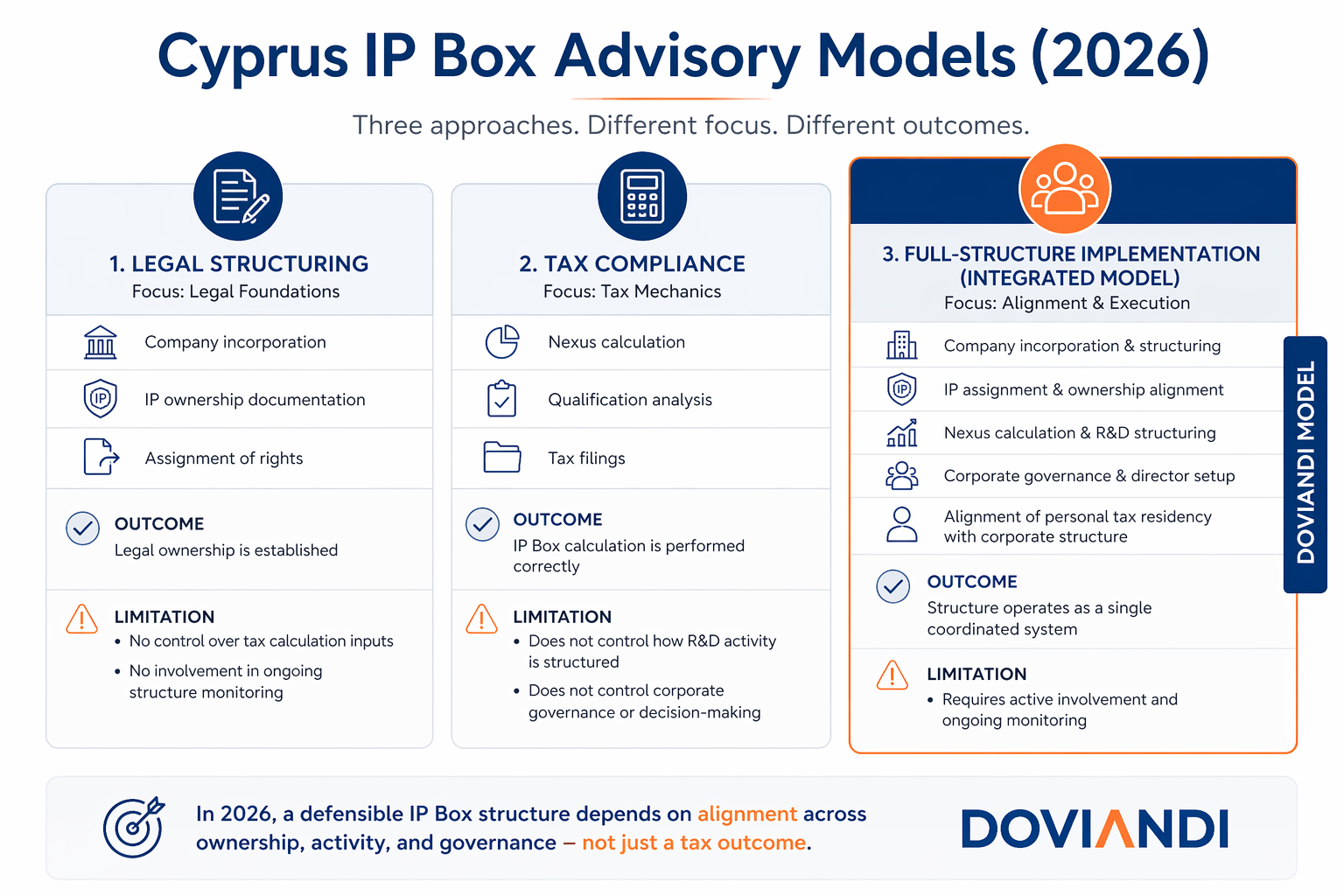
1. The Three Advisory Models in Practice

Cyprus IP Box advisory typically operates across three distinct models.

Model 1: Legal Structuring

Scope

  • Company incorporation
  • IP ownership documentation
  • Assignment of rights

Outcome

  • Legal ownership is established

Limitation

  • No control over tax calculation inputs
  • No involvement in ongoing structure monitoring

Model 2: Tax Calculation and Compliance

Scope

  • Nexus calculation
  • Qualification analysis
  • Tax filings

Outcome

  • IP Box calculation is performed correctly

Limitation

  • Does not control how R&D activity is structured
  • Does not control corporate governance or decision-making

Model 3: Full-Structure Implementation (Integrated Model)

Scope

  • Company incorporation and structuring
  • IP assignment and ownership alignment
  • Nexus calculation and R&D structuring
  • Corporate governance and director setup
  • Alignment of personal tax residency with corporate structure

Outcome

  • Structure operates as a single coordinated system

Limitation

  • Requires active involvement and ongoing monitoring

2. Decision Logic (2026 Application)

The appropriate model depends on the objective.

Objective Model Typically Applied
Establish IP ownership Legal structuring
Calculate tax exposure Tax compliance
Implement a defensible structure Full-structure implementation

For founders operating SaaS, AI, or cross-border IP models, the third model is typically required.


3. Where Cyprus IP Box Structures Fail

The framework follows the OECD Modified Nexus Approach under BEPS Action 5, which links tax benefits directly to qualifying R&D activity. In practice, structures are challenged based on how they operate, not how they were designed.

3.1 Expenditure Misalignment

  • Qualifying Expenditure (QE) not supported by actual R&D activity
  • Incorrect classification of costs

To understand how expenditure classification directly affects the outcome, see our detailed breakdown and model the calculation directly using the Cyprus IP Box calculator.


3.2 Nexus Weakness

  • Limited internal or third-party R&D
  • High acquisition cost relative to development activity

For a detailed technical breakdown of how the Nexus fraction is calculated and what qualifies as expenditure, see this comprehensive guide to the Cyprus IP Box Nexus Fraction


3.3 Management and Control

  • Strategic decisions taken outside Cyprus
  • Directors not aligned with actual control

3.4 Residency Conflicts

  • Personal tax residency not aligned with corporate structure
  • Exposure under Double Tax Treaty tie-breaker rules

For a numerical illustration of how these variables interact see a worked example of the Cyprus IP Box calculation with real numbers.


4. The 2026 Structural Requirements

A Cyprus IP Box structure is assessed across three layers:

Layer Requirement
Personal Cyprus tax residency supported by facts
Corporate Management and control exercised in Cyprus
Functional R&D activity supporting the Nexus calculation

Failure in any layer affects the overall position.

For a full technical overview of how these layers interact within the Cyprus IP Box regime, see the full Cyprus IP Box 2026 technical guide.


5. Implementation vs. Ongoing Operation

A common issue is treating the structure as complete once implemented.

In practice:

  • R&D activity evolves
  • expenditure profiles change
  • decision-making shifts

As a result, qualification under the IP Box must be maintained continuously.


6. Role of Advisory in Practice

At the implementation level, the distinction between advisory models becomes operational.

Full-structure implementation typically includes:

  • incorporation of the Cyprus company
  • structuring of IP ownership and assignment
  • setup of directors and governance framework
  • alignment of R&D activity with qualifying expenditure rules
  • coordination of personal tax residency with corporate structure
  • maintenance of documentation supporting management and control

7. Positioning of Doviandi

Doviandi operates within the full-structure implementation model, focusing on aligning IP ownership, R&D activity, and corporate governance into a single defensible system.

This includes:

  • incorporation and structuring of Cyprus companies
  • setup of local governance, including director framework
  • structuring IP assignments, including contribution in kind where applicable
  • aligning R&D activity with Nexus requirements
  • coordinating personal tax residency with the corporate position
  • maintaining documentation required for audit and cross-border review

The focus is on ensuring that:

  • the structure is correctly implemented
  • the structure remains consistent over time
  • the position is defensible under review

For a practical explanation of how these elements are implemented in real setups, see how Cyprus IP Box structures are implemented in practice.


Final Observation

In 2026, the Cyprus IP Box is not defined by a fixed tax outcome.

It is determined by three operational factors:

  • how ownership is structured
  • how activity is performed
  • how decisions are made

The advisory model determines whether these elements are aligned and defensible.


FAQ: Cyprus IP Box Advisory (2026)

What are the three types of Cyprus IP Box advisors?
Cyprus IP Box advisory typically falls into three models: legal structuring, tax compliance, and full-structure implementation. Each model focuses on a different layer of the structure.


Which type of advisor is required for SaaS founders?
For SaaS and technology founders, a full-structure implementation model is typically required, as it aligns IP ownership, R&D activity, and tax residency.


What does a Cyprus IP Box advisor actually do?
Depending on the model, advisory may include company incorporation, IP assignment, Nexus calculation, governance setup, and ongoing monitoring of the structure.


Can a Cyprus IP Box structure fail after setup?
Yes. Structures are typically challenged where expenditure does not support the Nexus calculation, or where management and control is not exercised in Cyprus.

Worked Example: Cyprus IP Box Calculation (2026) with Real Numbers

By Articles & Guides No Comments

The Cyprus IP Box effective tax rate depends on the Nexus calculation.

In the example below:

  • Overall Income (OI): €1,000,000
  • Qualifying Expenditure (QE): €400,000
  • Total Expenditure (OE): €700,000
  • Uplift (UE): €120,000

The resulting:

  • Qualified Profit (QP): €742,857
  • Taxable Profit (TP): €405,714
  • Payable Tax (PT): €60,857
  • Effective Tax Rate (ETR): 6.09%

1. Input Variables (2026 Scenario)

Assume a Cyprus company generating income from qualifying IP:

Variable Amount Explanation
OI (Overall Income) €1,000,000 Net IP income after direct costs
QE (Qualifying Expenditure) €400,000 Internal + third-party R&D
OE (Overall Expenditure) €700,000 Total R&D + acquisition cost
Asset Cost €300,000 IP acquisition value

2. Uplift Calculation

Uplift is calculated as:

  • 30% of QE = €120,000
  • Asset Cost = €300,000

Uplift (UE) = €120,000 (lower of the two)


3. Nexus Ratio

Nexus Ratio = (QE + UE) / OE

= (400,000 + 120,000) / 700,000
= 520,000 / 700,000
= 0.742857


4. Qualified Profit (QP)

QP = OI × Nexus Ratio

= 1,000,000 × 0.742857
= €742,857


5. IP Box Deduction

Deduction = 80% × QP

= 0.8 × 742,857
= €594,286


6. Taxable Profit (TP)

TP = OI – Deduction

= 1,000,000 – 594,286
= €405,714


7. Payable Tax (PT)

PT = TP × 15%

= 405,714 × 15%
= €60,857


8. Effective Tax Rate (ETR)

ETR = PT / OI

= 60,857 / 1,000,000
= 6.09%


9. Interpretation of the Result

This example shows:

  • The effective tax rate is not fixed
  • It depends on the Nexus ratio
  • The ratio is driven by QE relative to OE

Key drivers

Driver Impact
Higher QE Increases Nexus ratio
Higher OE (non-qualifying) Reduces benefit
Uplift Improves qualifying proportion

10. Alternative Scenario (High Nexus Structure)

If QE increases to €600,000 (with OE constant):

  • QE = €600,000
  • UE = €180,000 (capped at 30%)
  • Nexus Ratio = (600k + 180k) / 700k = 1.114 → capped at 1.0

QP = €1,000,000
Deduction = €800,000
TP = €200,000
PT = €30,000
ETR = 3.0%


Important Note

The Nexus ratio is effectively capped at 1.0, meaning:

  • maximum qualifying profit = total income
  • maximum deduction = 80% of income

11. What This Means Structurally

The effective tax outcome depends on:

  • how R&D is structured
  • whether expenditure qualifies under QE
  • how acquisition cost affects OE

This is why two companies with identical income can produce materially different tax outcomes.


12. Applying This to Your Structure

To model your own scenario using the 2026 framework:

Calculate your effective tax rate using the Cyprus IP Box calculator.


13. Implementation in Practice

In practice, achieving a targeted Nexus outcome requires coordination across:

  • R&D structuring (internal vs outsourced)
  • classification of expenditure
  • IP ownership and acquisition structure
  • alignment with the overall corporate model

Firms such as Doviandi work with founders to:

  • model expected Nexus outcomes before implementation
  • structure R&D flows to support qualifying expenditure
  • align IP ownership with operational activity
  • help ensure the resulting position is defensible under audit

Final Observation

The Cyprus IP Box regime is not defined by a fixed tax rate.

It is a calculation-driven system where:

  • inputs determine the outcome
  • structure determines the inputs

Numbers are only half the story. To understand how to implement the substance required for these calculations, read our SaaS and AI Operational Guide.

Cyprus IP Box 2026: Relocating Personally Held IP (Nexus & Tax Guide)

By Articles & Guides No Comments

The 2026 Principal’s Guide: Relocating Personally Held IP to Cyprus

Following the January 1, 2026 Cyprus Tax Reform, the landscape for relocating founders has shifted from mere “tax optimization” to “structural alignment.” For a principal holding software or digital Intellectual Property (IP) personally, the current framework provides a unique window to anchor both personal tax residency and IP ownership within a single jurisdiction operating under the OECD Nexus framework.

The application of these rules depends on the specific facts of each structure, including the nature of the IP, the form of the transaction, and the operational reality of the business.

To secure a defensible position, the structure must align three distinct layers:

Layer Requirement
Personal Cyprus tax residency (60-day or 183-day rule)
Corporate Cyprus company with management and control exercised in Cyprus
Functional R&D expenditure profile supporting the Nexus calculation

Where these are aligned, the Cyprus IP Box regime may apply. For a detailed look at how these principles apply specifically to software and AI companies, see our Operational Framework for Cyprus SaaS and AI companies.


1. Transitioning Personally Held IP (Assignment of Rights)

When IP is held personally, it is transferred to a Cyprus company through an Assignment of Rights.

Core requirements

Requirement Explanation
Legal assignment Transfers ownership from individual to company
Arm’s length assignment The assignment must reflect an arm’s length value, typically supported by a Fair Market Value (FMV) assessment
Consideration May be cash or contribution in kind (e.g. share issuance)

Tax treatment

  • The IP is recognised as an intangible asset in the Cyprus company
  • The acquisition value becomes the asset cost for tax purposes
  • This cost is generally amortised for tax purposes subject to the nature of the asset and applicable tax treatment

This amortisation is a deductible expense in calculating Overall Income (OI). This treatment affects the calculation of taxable profit but does not directly impact the Nexus ratio.


2. Cyprus IP Box Calculation (2026 Model)

The Cyprus IP Box regime provides an 80% deduction on Qualified Profit (QP).

The calculation is defined as follows:


Core variables

Variable Definition
OI (Overall Income) License income + embedded IP income – direct costs
OE (Overall Expenditure) Total R&D expenditure + acquisition cost
QE (Qualifying Expenditure) Internal R&D + third-party (unrelated) R&D
UE (Uplift Expenditure) Lower of 30% of QE or (Asset Cost + related R&D)
The treatment of uplift and its interaction with overall expenditure depends on how qualifying and non-qualifying costs are categorised

Calculation sequence

QP = OI × ((QE + UE) / OE)
Deduction = 80% × QP
TP = OI – Deduction
PT = TP × 15%
ETR = (PT / OI) × 100%

To see how these variables interact with your specific project figures, you can Calculate your 2026 ETR using our dedicated IP Box calculator.


Interpretation

  • The benefit depends on the ratio of QE to OE
  • Third-party (unrelated) outsourcing is included in QE (For a technical breakdown on How remote teams affect Qualifying Expenditure, refer to our guide on cross-border R&D)
  • Acquisition cost increases OE but does not increase QE

There is no fixed effective tax rate. The outcome is determined by the structure of expenditure.


3. Nexus Requirement (Operational Condition)

The Cyprus IP Box is fully compliant with the OECD Modified Nexus Approach (Action 5), ensuring your structure meets international standards for tax transparency. The Nexus framework links the tax benefit to qualifying R&D activity.

Key rule

Only the portion of income corresponding to the QE/OE ratio is eligible for the 80% deduction.


Practical scenarios

Structure Result
R&D performed internally or via unrelated contractors Included in QE
R&D via related parties Excluded from QE
IP acquired with limited own development Lower QE / OE ratio

4. Cyprus Tax Residency (60-Day Rule – 2026)

To qualify as a tax resident under the 60-day rule, the following cumulative conditions must be met:

Requirement Condition
Presence ≥ 60 days in Cyprus
Global limit ≤ 183 days in any other single country
Activity Director or employee of Cyprus company
Residence Permanent home available in Cyprus

Dual residency

Cyprus may grant tax residency under domestic law.

Where another jurisdiction also claims residency, the position is determined under Double Tax Treaty (DTT) tie-breaker rules, typically:

  1. Permanent home
  2. Centre of vital interests
  3. Habitual abode

These criteria are applied based on factual circumstances and are not determined solely by formal criteria.


5. Management and Control (Corporate Residency)

A Cyprus company is tax resident where management and control is exercised.

Indicators examined by authorities:

Area Indicator
Decision-making Strategic decisions taken in Cyprus
Directors Individuals exercising control
Governance Board minutes and records
Commercial reality Consistency between documented decisions and the actual conduct of the business

6. Conditions Where the Structure Is Challenged

Challenges typically arise where:

  • the assignment is not supported by a defensible valuation
  • the Nexus ratio is not supported by actual expenditure
  • management and control is exercised outside Cyprus
  • residency position is not defensible under treaty rules

7. Structural Implementation (Execution Layer)

Implementing this structure requires coordination across:

Corporate

  • incorporation of Cyprus entity
  • IP ownership alignment

Tax

  • Nexus calculation based on actual expenditure
  • amortisation of asset cost

Governance

  • documentation of decision-making
  • alignment with management and control requirements

8. Implementation in Practice (Advisory Layer)

At this level, the structure is not defined by individual steps, but by whether all elements operate coherently in practice.

For founders relocating with personally held IP, this typically requires coordination across:

  • IP assignment and valuation
  • Nexus calculation and R&D structuring
  • personal tax residency position
  • corporate management and control

In practice, these elements are implemented and monitored by advisory firms specialising in cross-border structuring.

Firms such as Doviandi focus on:

  • structuring IP assignments, including contribution in kind where appropriate
  • aligning R&D activity with Nexus requirements
  • coordinating personal residency with corporate tax position
  • implementing governance frameworks supporting management and control
  • maintaining documentation required for audit and treaty defence

The role of advisory is therefore not limited to setup, but to ensuring that the structure remains consistent with the legal and tax framework over time.


9. Scope of Application

This structure is typically relevant for:

  • founders holding software or digital IP personally
  • SaaS or technology-driven business models
  • individuals relocating from higher-tax jurisdictions
  • structures involving cross-border R&D activity

Final Observation

The Cyprus IP Box regime operates through:

  • the Nexus calculation
  • the treatment of expenditure
  • the location of management and control

The outcome is not a fixed rate.

It is determined by how the structure is implemented and maintained.

Cyprus IP Box Nexus Fraction Calculation for Remote Teams

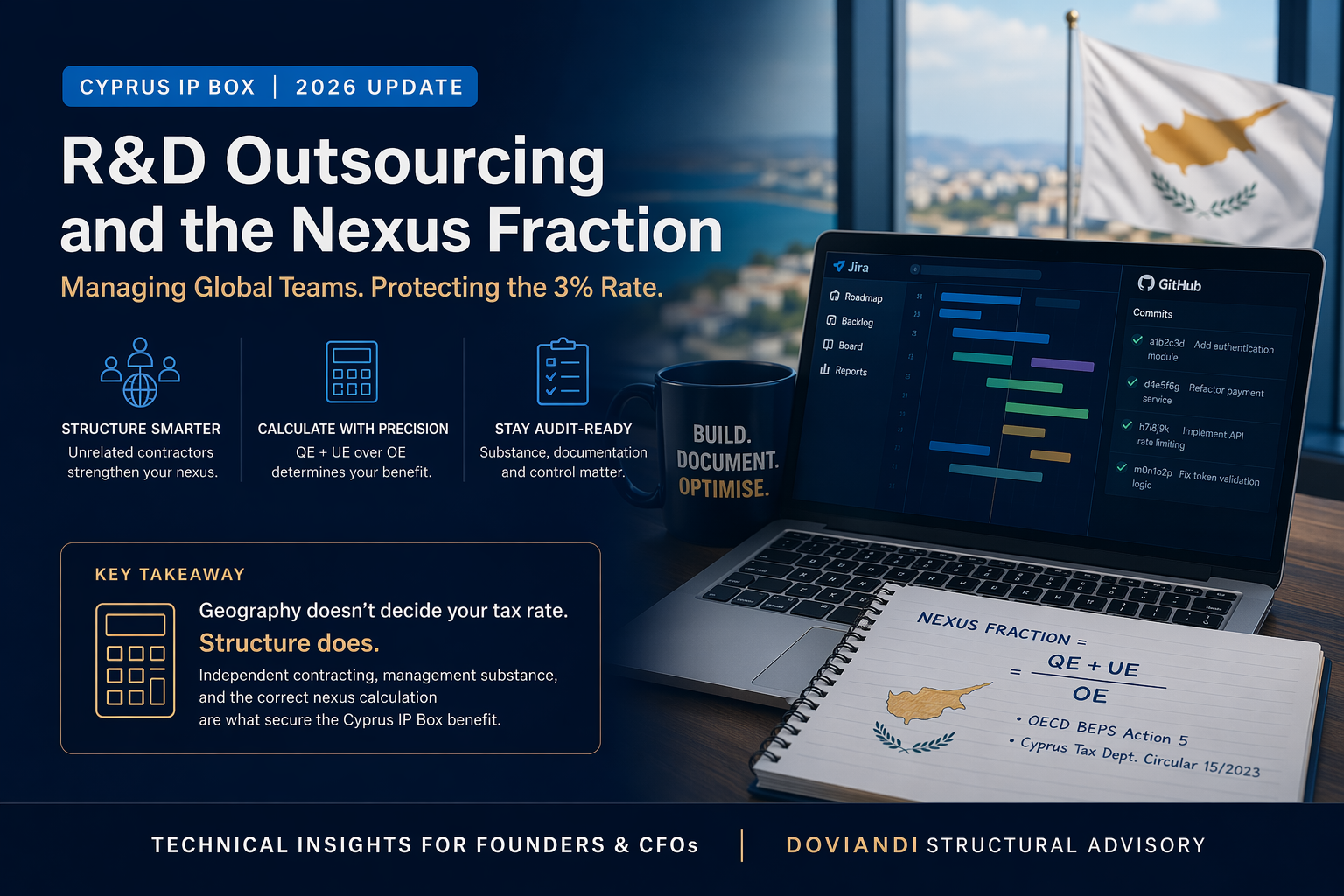
R&D Outsourcing and the Nexus Fraction: A Technical Advisory Note on Managing Distributed Teams under the Cyprus IP Box (2026)

By Articles & Guides No Comments

Technical Advisory Note

This document reflects structuring considerations applied in Cyprus IP Box engagements involving distributed SaaS and AI companies. It is intended for informational purposes and illustrates how nexus outcomes depend on outsourcing models, operational substance, and documentation under the OECD-modified nexus framework.


Executive Summary

The primary compliance risk for distributed SaaS and AI groups under the Cyprus IP Box regime is the misclassification of R&D outsourcing.

While the OECD Modified Nexus Approach encourages local substance, it creates a structural constraint for companies using global development teams.

Under OECD BEPS Action 5:

  • R&D outsourced to related parties is excluded from Qualifying Expenditure (QE)
  • R&D outsourced to independent contractors remains fully qualifying, regardless of geography

For a remote-first business, the difference between an effective tax rate of ~3% and 15% often hinges on the legal and operational relationship between the Cyprus IP owner and the developers — not where those developers are located.

This technical note should be read together with our broader Cyprus SaaS & AI Company Structures (2026) framework, which examines how distributed development, management and control, IP ownership, and exit-readiness interact within Cyprus technology structures.


Technical Summary: Outsourcing Impact Matrix

Expenditure Type Entity Relationship QE Eligibility Impact on Nexus Fraction
Direct Salaries Cyprus Entity Employees 100% Positive (Increases Numerator)
Unrelated Outsourcing Independent Contractors / Agencies 100% Positive (Increases Numerator)
Related Outsourcing Group Subsidiaries / Parent Co 0% Negative (Inflates Denominator Only)
IP Acquisition External or Group Purchase 0% Negative (Requires Uplift Buffer)

The Nexus Framework (2026 Context)

Under the Cyprus IP Box regime (see: Cyprus IP Box Regime), qualifying profits are calculated using the nexus fraction:

Nexus Fraction = (QE + UE) / OE

Where:

  • QE = Qualifying Expenditure
  • UE = Uplift Expenditure
  • OE = Overall Expenditure

This formula determines the portion of IP income eligible for the 80% tax deduction, resulting in an effective tax rate of approximately 3% when properly structured.


The Related vs. Unrelated Party Filter

Outsourcing introduces a binary classification that directly impacts the nexus fraction.


1. The Related-Party Trap

R&D outsourced to group entities (e.g., development subsidiaries in CIS, India, or other jurisdictions) is classified as related-party expenditure.

Under BEPS Action 5:

  • these costs are excluded from QE
  • but still included in OE

Result:

  • denominator increases
  • numerator remains unchanged
  • nexus fraction compresses

This can rapidly push the effective tax rate toward the standard 15% corporate rate.


2. The Unrelated-Party Advantage

R&D outsourced to independent contractors or third-party providers is treated as unrelated-party expenditure.

These costs:

  • are fully included in QE
  • contribute directly to the numerator

Key principle:

Geography is not the disqualifier — the relationship is.

A distributed team of independent developers may therefore be structurally more efficient for nexus purposes than a centralized related-party development subsidiary. Managing remote development teams requires a coordinated governance structure. We explain this in detail in our SaaS Operational Framework.


Substance of Management: Anchoring Control in Cyprus

While development activity can be geographically distributed, Cyprus requires substantive economic ownership.

Per Cyprus Tax Department guidance (e.g. Circular 2016/10 and the Transfer Pricing framework under Circular 5/2023), the Cyprus entity must demonstrate control over Core Income Generating Activities (CIGA).

This includes:

  • Technical Roadmaps → defining what is built and why
  • Risk Assumption → bearing financial risk of R&D outcomes
  • IP Governance → ensuring legal ownership and assignment

Practical Implementation Signals

Audit-defensible structures typically include:

  • Product and technical decisions originating from Cyprus
  • Board or management-level oversight of development
  • Legal ownership of all IP by the Cyprus entity
  • Alignment between contracts, accounting, and actual operations

Failure to anchor these elements in Cyprus may lead to:

  • reclassification of expenditure
  • reduced nexus eligibility
  • audit exposure

The 30% Uplift as a Structural Buffer

The Uplift Expenditure (UE) provides partial recovery for non-qualifying costs:

UE = min(30% × QE, Non-Qualifying R&D + Acquisition Costs)


Case Example: Hybrid Remote Structure

  • QE (Independent Contractors): €700,000
  • Related Party R&D: €300,000
  • OE: €1,000,000

Uplift:

  • 30% × QE = €210,000

Adjusted Nexus Fraction:

(700,000 + 210,000) / 1,000,000 = 0.91

Comparison:

  • Without uplift → 0.70
  • With uplift → 0.91

This materially improves the effective tax outcome and preserves access to the IP Box benefit.


Audit-Defensible Structure: Technical Artifacts

To sustain a high nexus fraction under audit conditions, structures typically require:

  • Independent Service Agreements
    → Explicit “unrelated party” status
    → Automatic IP assignment clauses
  • Technical Gatekeeping Evidence
    → Systems such as Jira / GitHub demonstrating approval flows from Cyprus
  • Direct Payment Flows
    → Payments from Cyprus entity to contractors
    → Avoidance of centralized group treasury routing
  • Nexus Fraction Review
    → Annual reconciliation of QE vs OE
    → Documentation supporting classification decisions

In practice, these elements are supported through:

  • nexus modelling
  • transfer pricing analysis
  • contemporaneous documentation

The IP Box Nexus Compliance Checklist (2026 Framework)

This checklist provides a high-level diagnostic tool for assessing structural alignment.

Section 1: Contractual & Entity Architecture

  • IP qualifies as a Qualifying Intangible Asset
  • Cyprus entity holds legal and beneficial ownership
  • R&D expenditure correctly classified (related vs unrelated)
  • Contractor agreements include automatic IP assignment

Section 2: Mathematical Nexus Alignment

  • Separation of QE vs OE in accounting records
  • Correct application of uplift (UE)
  • Annual nexus fraction review

Section 3: Operational Substance (CIGA)

  • Strategic decisions exercised in Cyprus
  • Evidence of development oversight
  • Alignment between operations and legal structure

Section 4: Audit Readiness

  • Alignment with Cyprus Tax Department guidance
  • Transfer pricing support where applicable
  • Evaluation of tax ruling requirements depending on structure

Frequently Asked Questions (FAQ)

Q1: Does the 15% corporate tax rate affect IP Box eligibility?
No. The 15% rate (effective 1 January 2026) increases the effective rate from ~2.5% to ~3%, but the underlying 80% deduction mechanism remains unchanged.

Q2: Can R&D be performed outside Cyprus?
Yes. R&D can be performed globally, provided the Cyprus entity retains control and the outsourcing structure meets nexus requirements.

Q3: Do contractors in the UAE, US, or other jurisdictions qualify?
Yes — provided they are independent (unrelated) parties and properly contracted by the Cyprus entity.

Q4: What if the business already has a foreign development subsidiary?
The structure must account for related-party expenditure through:

  • uplift application, or
  • restructuring of development arrangements

Q5: Is a tax ruling always required?
Not always. In higher-risk or complex scenarios (e.g. pre-existing IP, cross-border structures), a tax ruling may be recommended to secure treatment.


Practical Structuring Considerations

The application of the IP Box regime depends on:

  • development history of the IP
  • jurisdictional footprint
  • ownership structure
  • stage of the business

In practice:

  • some structures are modelled prior to incorporation
  • others are documented during implementation to support future tax rulings

Each case must align:

  • legal form
  • operational reality
  • financial outcomes

Related Resources


Professional Disclaimer

This document is provided for informational purposes only and does not constitute legal or tax advice. The Cyprus IP Box regime is a technical framework requiring proper structuring, implementation, and ongoing compliance.

Cyprus IP Box calculation nexus fraction formula 2026

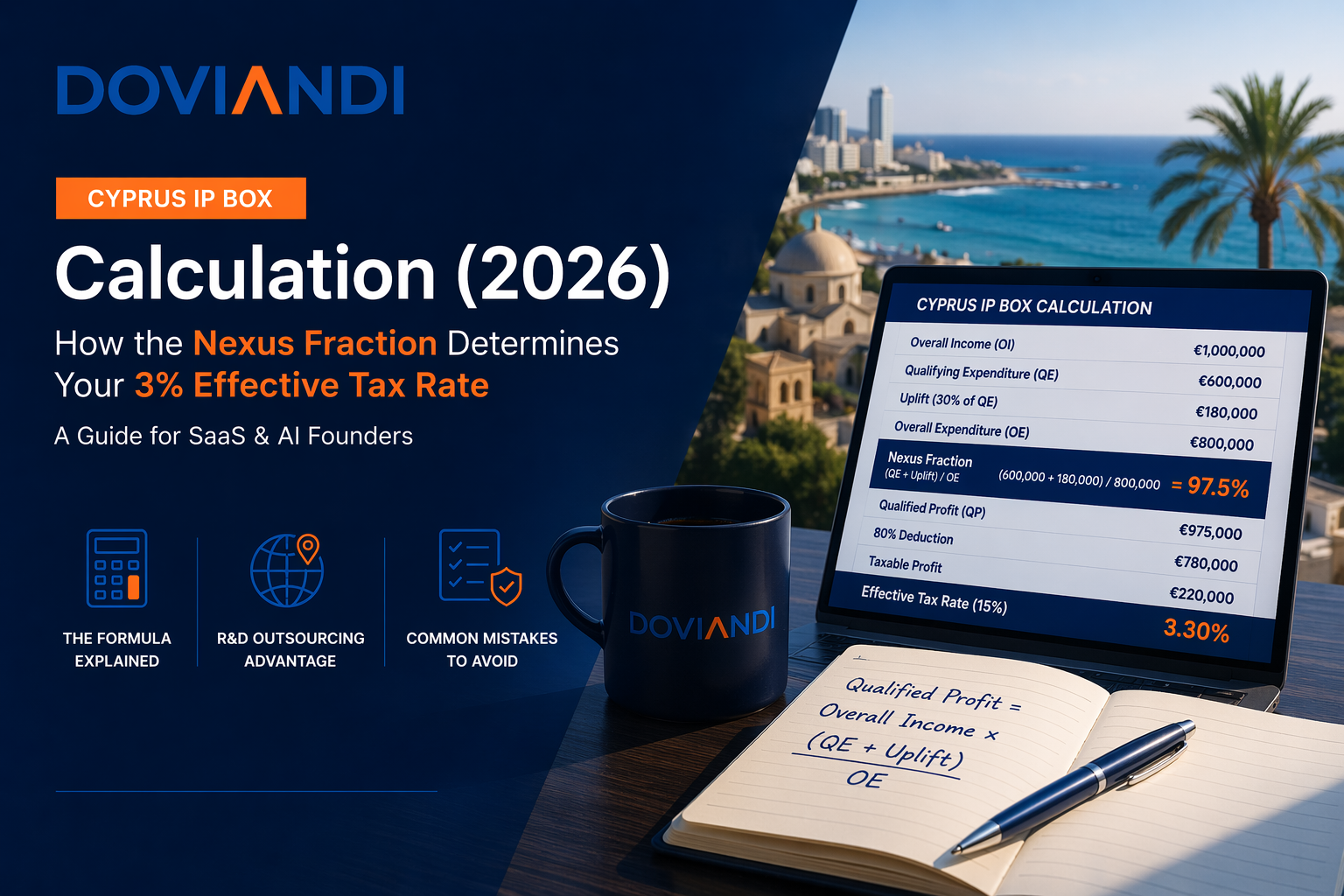
Cyprus IP Box Calculation (2026): Nexus Fraction Explained for SaaS & AI Founders

By Articles & Guides No Comments

Understanding the Cyprus IP Box calculation is no longer optional for SaaS and AI founders. With the corporate tax rate now at 15%, the difference between a standard tax position and an optimized structure comes down to one variable: the Nexus Fraction.

This is the mechanism that determines whether your effective tax rate is closer to 15% or closer to 3%. In this guide, we break down exactly how the Cyprus IP Box calculation works, what founders often get wrong, and how to structure your R&D correctly to maximize your deduction.

Quick Answer: How the Cyprus IP Box Calculation Works

The Cyprus IP Box effective tax rate is calculated by applying an 80% deduction to profits derived from qualifying intellectual property. The final tax outcome depends on the Nexus Fraction:

  • If Qualifying Expenditure is high: The effective tax rate approaches ~3%.

  • If Qualifying Expenditure is low: The effective tax rate increases toward 15%.

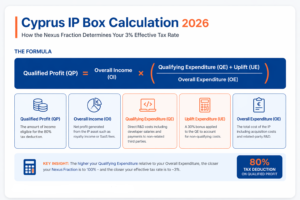
The Core Formula:

Qualified Profit = Overall Income × [(Qualifying Expenditure + Uplift) / Overall Expenditure]

This determines how much of your income benefits from the 80% exemption.

Cyprus IP Box Calculation: The Formula Explained

The Nexus Fraction is a formula derived from the OECD Modified Nexus Approach. This international standard ensures that tax benefits are directly linked to the R&D expenditure incurred by the company.

The calculation variables are:

  • Qualified Profit (QP): The amount of income eligible for the 80% tax deduction.

  • Overall Income (OI): The net profit generated from the IP asset (Royalty income, SaaS fees).

  • Qualifying Expenditure (QE): Direct R&D costs including salary for developers and payments to non-related third parties.

  • Uplift Expenditure (UE): A 30% bonus applied to the QE to account for non-qualifying costs.

  • Overall Expenditure (OE): The total cost of the IP including acquisition costs and related-party R&D.

Cyprus IP Box calculation nexus fraction formula 2026

Example: Cyprus IP Box Calculation in Practice

To see how these variables interact, consider a SaaS company generating €1,000,000 in qualifying income:

  1. Qualifying Expenditure (QE): €600,000 (Internal dev salaries + third-party contractors).

  2. Uplift (UE): €180,000 (The 30% “bonus” calculation).

  3. Overall Expenditure (OE): €800,000 (Total costs including a small IP acquisition fee).

The Calculation:

  • Nexus Fraction: (600,000 + 180,000) / 800,000 = 97.5%

  • Qualified Profit: €1,000,000 × 97.5% = €975,000

  • 80% Deduction: €780,000 (This amount is tax-free).

  • Taxable Profit: €220,000

  • At a 15% Corporate Tax Rate: Tax = €33,000

  • Effective Tax Rate: 3.3%

To model your own scenario, use our Cyprus IP Box Calculator (calculate your effective tax rate).

The Third-Party Advantage: R&D Outsourcing

One of the most powerful features of the Cyprus IP Box is its treatment of third-party outsourcing. Many founders believe that all R&D must be performed by employees physically located in Cyprus. This is a common misconception.

Payments made to non-related parties for R&D work, such as hiring a specialized development team in India or a freelancer in South America or Eastern Europe, count as Qualifying Expenditure. This spend directly increases your Nexus Fraction. By contrast, if you pay a subsidiary or a related company for that same work, the spend is classified as non-qualifying, which lowers your fraction and increases your tax rate.

Common Mistakes in Cyprus IP Box Calculation

Most founders do not get the Nexus Fraction wrong because it is complex. They get it wrong because they misunderstand what qualifies. Common issues include:

  1. Related-Party R&D: Treating payments to your own foreign subsidiaries as qualifying expenditure. This reduces your fraction.

  2. IP Acquisition: Buying IP instead of developing it. Acquisition costs dilute the benefit unless supported by ongoing development.

  3. Poor Documentation: If R&D activity is not documented, it does not exist during due diligence.

  4. Legal vs. Operational Misalignment: Creating a gap between where the IP is legally held and where the development is actually managed.

Structural Integrity and Exit Readiness

Building a defensible structure is about more than tax. During a merger or acquisition, the due diligence process will scrutinize your Cyprus IP Box calculation. As explored in our Cyprus Tech Company Structure guide and our analysis on Selling a SaaS Company in Cyprus, poorly documented R&D activity creates “structural debt.”

If you are still evaluating whether Cyprus is the right choice for your venture, see our Cyprus Company Formation for Tech Companies guide.

When Calculation Becomes Structure

Most founders use calculators to estimate outcomes. Very few understand how those outcomes hold under investor due diligence, cross-border operations, and exit scenarios. If you are moving from estimation to actual structuring, that is where decisions start to matter.

Book a Cyprus Strategy & Discovery Call
A direct session to map out your structural path and define your roadmap for 2026.


FAQ: Common Questions on the Cyprus IP Box

Does the 15% CIT change the IP Box benefits?

The baseline tax rate is 15%, but the 80% deduction on qualified profits remains. This means the effective tax rate for companies with a high Nexus Fraction remains approximately 3%.

Can I use developers in India or Eastern Europe?

Yes. Payments to unrelated third-party developers qualify as R&D expenditure. This spend helps maintain a high Nexus Fraction.

How do I maximize the Cyprus IP Box deduction?

By increasing qualifying R&D expenditure and minimizing non-qualifying costs such as related-party outsourcing and IP acquisition.

Is the Cyprus IP Box suitable for AI companies?

Yes. AI models, algorithms, and software qualify as intellectual property, provided development activity is properly documented and aligned with Nexus requirements.

Selling a SaaS Company in Cyprus

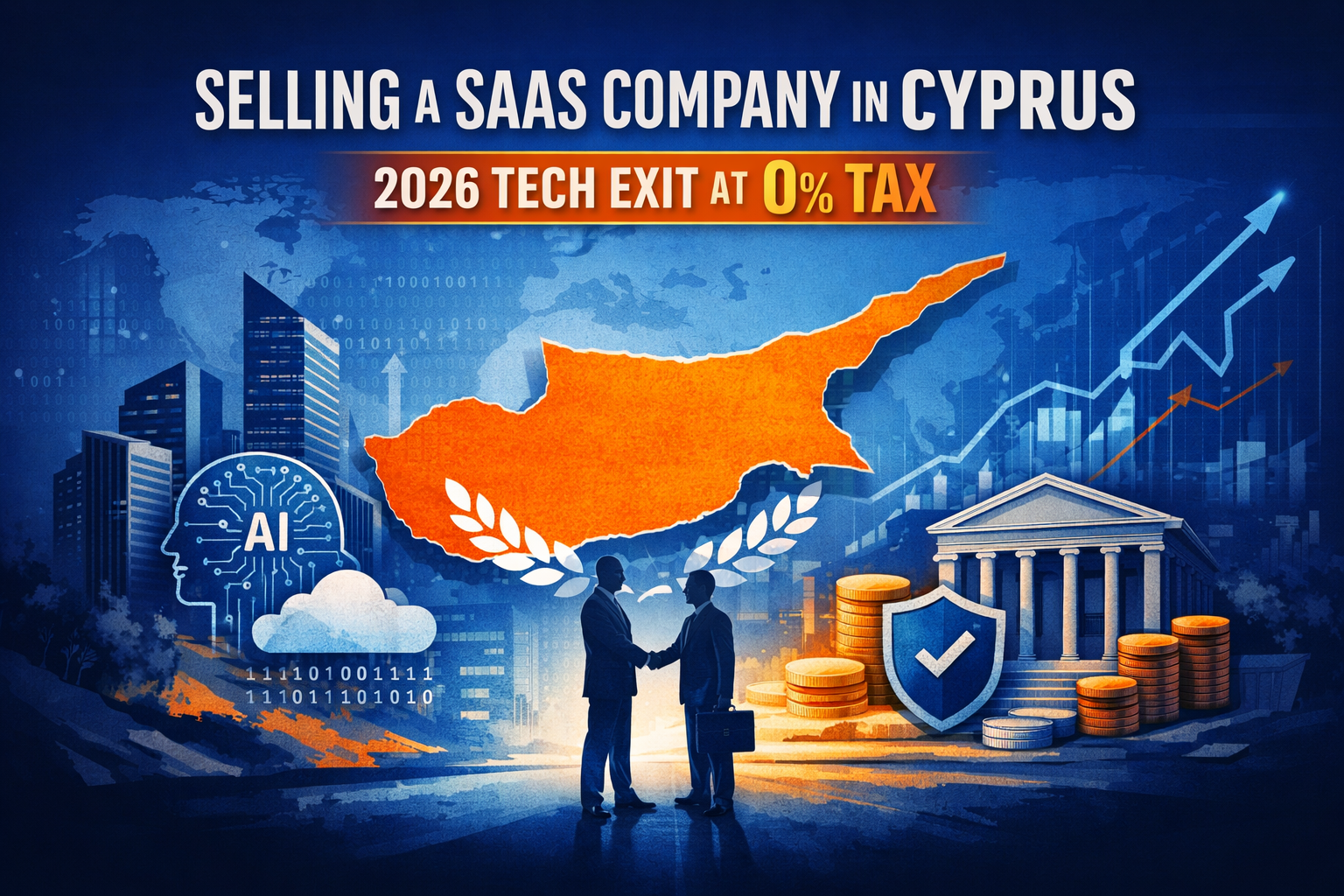
Selling a SaaS Company in Cyprus: The Strategic 2026 Exit Framework

By Articles & Guides, Business No Comments

Selling a SaaS company in Cyprus, or exiting a high-growth AI-led enterprise, is a structural outcome rather than a closing-day decision. In the 2026 regulatory environment, a tax-efficient realization of capital is the result of a “Substance-First” architecture built across four distinct layers:

  • Shareholding architecture

  • IP positioning

  • Tax residency

  • Economic substance

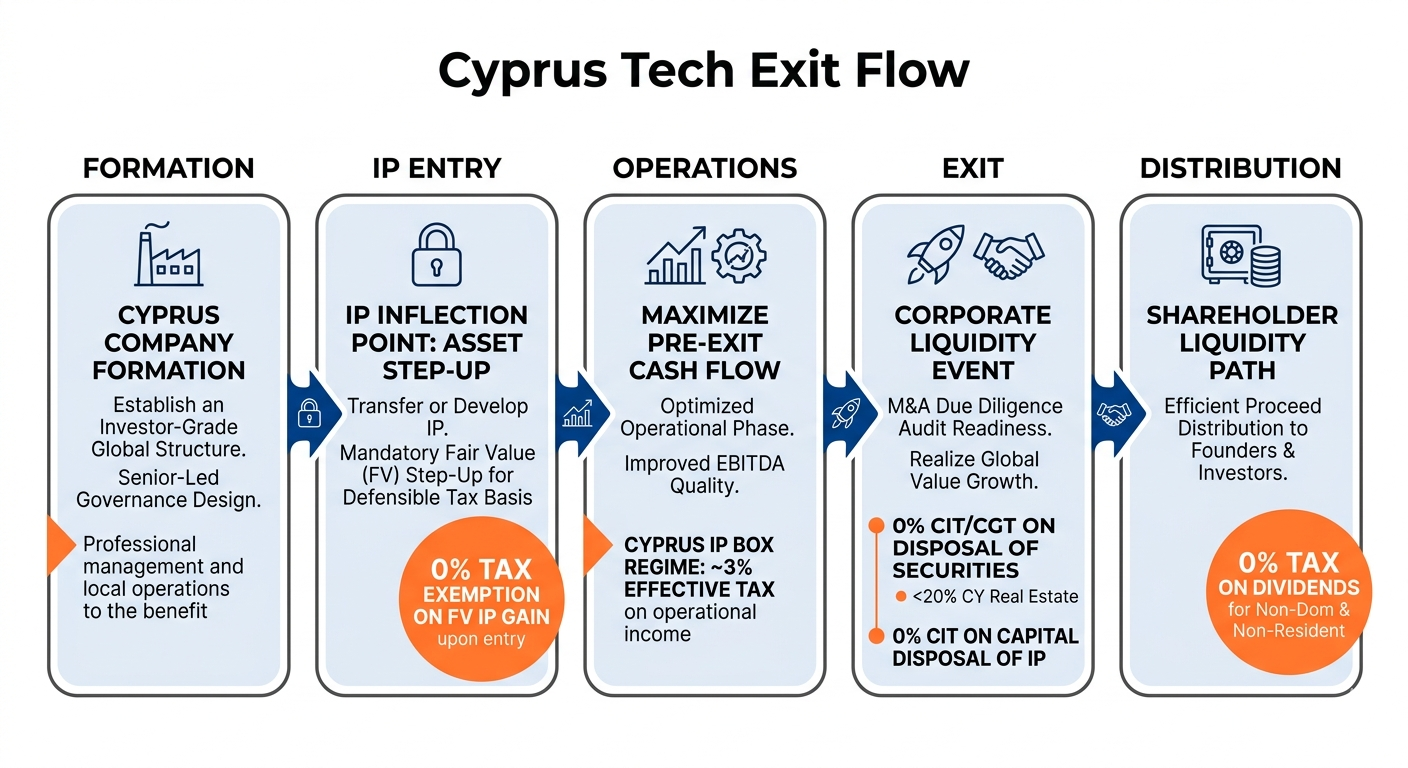
This is the Exit Integrity Threshold. A Cyprus tech exit qualifies for 0% tax only when legal form, asset composition, and substance align under audit conditions. For founders, this process begins years earlier at the stage of Cyprus Company Formation, ensuring the structure is “exit-ready” from day one.

cyprus tech exit flow


1. The Share Sale Standard (2026)

The primary and most defensible path for selling a SaaS company in Cyprus is a share sale. A share sale is the standard method for selling a SaaS company in Cyprus because it qualifies for a 0% tax exemption under specific conditions. Under the 2026 framework (effective 1 January 2026), the tax treatment remains globally competitive:

  • Corporate Income Tax (CIT): Gains on share disposals are Exempt.

  • Capital Gains Tax (CGT): 0%, subject to the real estate threshold.

The 20% Real Estate Exposure Test

This threshold was tightened in 2026 and serves as a primary diligence checkpoint.

Condition Tax Outcome
20% or less of value linked to Cyprus real estate 0% Tax (Exempt)
More than 20% exposure to Cyprus real estate Capital Gains Tax Risk

For SaaS, AI, and IP-heavy firms, which are typically asset-light, this is usually not a constraint. However, most failures occur when real estate is indirectly held through operating subsidiaries. Important: Buyers test this early; if breached, both the deal structure and the valuation will change.


2. Why Cyprus is the Global Hub for Tech Liquidity

Cyprus remains a premier jurisdiction for technology exits due to a convergence of robust fiscal incentives:

  • 0% Tax on Share Disposals: Comprehensive exemption for the sale of titles.

  • 0% Capital Gains Tax on IP: Profits from the disposal of Intellectual Property (IP) of a capital nature are generally exempt from tax.

  • Effective 3% Rate: Operational income optimized under the Cyprus IP Box Regime which provides an effective 3% tax rate on qualifying profits.

  • Zero Withholding Tax: No tax on outbound dividends to non-resident or Cyprus Non-Dom Residency shareholders.

  • Regulatory Alignment: Full compliance with EU Tax Directives and OECD Pillar Two standards.

Cyprus is not competitive because of one tax rule. It is competitive because multiple tax, legal and regulatory advantages align into a single structure.


3. Asset Sales and the Capital Nature Test

While share deals are the standard, some buyers request the direct acquisition of IP. This introduces a classification test under the 15% Corporate Income Tax regime.

Capital vs. Trading Treatment

The distinction between inventory and capital assets must be defensible under audit conditions.

  • Capital Disposal: Profits from the disposal of IP assets that form part of the company’s permanent capital base are generally exempt from tax.

  • Trading Income: If the disposal is deemed an integral part of recurring commercial activity, it is subject to the 15% CIT.

If the IP is not clearly separated as a capital asset, buyers assume tax risk and may seek aggressive escrow retentions.


4. The IP Inflection Point

The tax outcome of an exit is often determined at the IP Inflection Point — the moment IP enters the jurisdiction. When IP is transferred or developed in Cyprus, its valuation must reflect market reality through a Fair Value (FV) Step-up.

This step also defines the future tax baseline used by both auditors and acquirers. Without this discipline, the audit trail for pre-entry value vs. Cyprus-generated growth becomes obscured, making the capital treatment harder to support.


5. Equity Efficiency: NID and Exit Valuation

The Notional Interest Deduction (NID) directly impacts how buyers assess financial quality. NID allows new equity (including IP contributed at Fair Value) to generate a deemed interest deduction of up to 80% of taxable profits.

In practice, buyers rely on the higher cash retention the NID creates. By improving EBITDA quality and cash conversion, the NID strengthens the financial metrics used to calculate the final exit multiple.


6. Substance and the ATAD 3/Pillar Two Risk

A Cyprus structure must demonstrate real economic activity to withstand international scrutiny. This is the Substance Trigger Event. Under EU ATAD 3 (Unshell Directive) and OECD guidelines, buyers assess:

  1. Authority: Where strategic decisions are made and if directors have real authority.

  2. Control: Whether the company genuinely controls its IP assets.

  3. Operations: Whether the local infrastructure matches the revenue scale.

In 2026, substance reviews are often conducted before financial due diligence is finalized. Structures without this level of substance are increasingly rejected during institutional due diligence. Examples of how it works in practice can be found in our Cyprus IP Holding Company Structure article.


2026 Tech Exit Comparison Matrix

Disposal Layer Mechanism Tax Treatment Strategic Goal
Corporate Exit Share Sale 0% Tax Maintain <20% Real Estate value
IP Disposal Asset Sale 0% or 15% Classify as Capital Nature
Operations IP Box Approx. 3% Nexus / R&D compliance
Cash Flow NID Up to 80% deduction Improve cash conversion
Distribution Dividends 0% Tax Optimize via Non-Dom status

The Tech Exit Ecosystem

To meet the Exit Integrity Threshold, founders should review our supporting frameworks:


FAQ: Selling a SaaS Company in Cyprus

Is a share sale always tax-free in Cyprus? Yes, provided the company does not exceed the 20% real estate exposure threshold. For most AI and SaaS companies, this is the default exit path.

Do buyers prefer share sales or asset sales in Cyprus? Buyers generally prefer share sales due to greater tax certainty and reduced reclassification risk under EU frameworks.

Can software or IP be sold tax-free? Yes, if the disposal is of a capital nature. If treated as trading income, it is subject to the 15% CIT.

What is a Fair Value Step-up? It is the recognition of IP at market value upon entry into Cyprus, creating a defensible tax base and supporting future NID claims.

Does NID reduce tax before exit? Yes. It can reduce taxable profits by up to 80%, maximizing cash flow and financial metrics in the years leading to the sale.

How does ATAD 3 affect an exit? If a company lacks substance, it may be classified as a “shell,” which could jeopardize the 0% exit benefits during buyer due diligence.


A 0% Exit Is Engineered Early

A successful exit is not created during negotiations. Success is the result of Intellectual Property Structuring, Governance Design, and Residency Alignment. If these are correct, the tax outcome follows.

Doviandi advises founders and investors on Cyprus structures designed for audit resilience and investor-grade exits.

Request a structural audit to determine whether your current setup meets the Exit Integrity Threshold before a future transaction.

Cyprus IP Holding Company

Cyprus IP Holding Company Structure: How It Works in Practice (2026)

By Articles & Guides No Comments

Introduction

The Cyprus IP Box regime is widely referenced in discussions around intellectual property and international structuring.

What is less clearly explained is how a Cyprus IP holding company actually operates in practice.

This matters.

The effectiveness of any IP structure depends not on the regime itself, but on:

  • how ownership is established

  • how income flows are structured

  • how substance and governance are implemented

This article outlines how a Cyprus IP holding structure is typically set up and maintained in a compliant and defensible manner. It focuses on practical implementation rather than theoretical tax outcomes.


1. What is a Cyprus IP Holding Company

A Cyprus IP holding company is a Cyprus tax resident entity that:

  • owns qualifying intellectual property

  • licenses that IP to operating companies

  • receives royalty or licensing income

This structure separates:

  • ownership of IP (Cyprus entity)

  • commercial operations (operating entity)

This separation is widely used in technology and IP-driven businesses to protect core assets and centralise value.

In practice, the setup and operation of a Cyprus IP holding company requires careful alignment between legal ownership, development activity and ongoing governance.


2. How the Structure Works

A typical structure involves two main components:

A. Cyprus IP Holding Company

  • Holds legal and economic rights to the IP

  • Maintains documentation and ownership records

  • Licenses IP to related or third-party entities

  • Receives royalty income


B. Operating Company (local or international)

  • Contracts with customers

  • Generates revenue

  • Pays royalties to the Cyprus IP company


Simplified Flow

  1. Operating company generates revenue

  2. Pays royalty for use of IP

  3. Cyprus IP company receives income

  4. IP income is assessed under Cyprus tax rules


3. The Role of the IP Box Regime

Cyprus applies an 80% deduction on qualifying IP profits.

Given the corporate tax rate of 15%, this can result in an effective tax rate of approximately 3% on qualifying income. The practical outcome depends on the specific facts of each structure and can be modelled using an IP Box calculator.

This outcome depends on the specific facts of the structure and is not automatic.

It depends on:

  • the nature of the IP

  • the underlying R&D activity

  • the nexus between development and income

For a detailed explanation of how the Cyprus IP Box regime operates, including qualifying income and calculation methodology, see our guide.


4. The OECD Nexus Requirement (Critical)

The Cyprus IP regime follows the OECD modified nexus approach.

This requires a direct link between:

  • R&D activity

  • ownership of IP

  • income derived from that IP

In practice, this means:

  • qualifying expenditure must be tracked

  • development activity must be evidenced

  • structures without substance will not qualify

The calculation of qualifying income is based on the proportion of R&D expenditure relative to total IP costs.


5. How IP is Positioned in the Structure

There are two common approaches:


A. Development within the Cyprus company

  • IP is created inside the Cyprus entity

  • R&D activity is carried out or managed there

  • Nexus position is typically strong

This is often the cleanest approach from a compliance perspective.


B. Transfer of existing IP into Cyprus

  • IP is transferred from another group entity

  • Requires valuation and transfer pricing support

  • Nexus position starts lower and improves over time

In this case, future development activity in Cyprus becomes critical.


6. Key Compliance Requirements

A Cyprus IP holding structure requires ongoing discipline.

A. Documentation

  • IP ownership records

  • licensing agreements

  • R&D activity records

  • nexus calculations


B. Transfer Pricing

  • royalty rates must be commercially justified

  • intercompany agreements must be aligned with actual activity


C. Substance

  • decision-making must occur in Cyprus

  • director involvement must be real

  • activities must align with the structure

Structures that do not meet economic substance requirements in Cyprus are likely to be challenged or disregarded.

Cyprus operates within the broader EU framework, including alignment with the EU Code of Conduct on Business Taxation.


7. What Does Not Qualify as IP

Not all assets fall within the Cyprus IP regime.

Typically excluded:

  • trademarks

  • brand value

  • customer lists

Qualifying assets generally include:

  • software

  • patents

  • technical know-how linked to R&D activity


8. Where Structures Commonly Fail

In many cases, issues arise not from the regime itself, but from incorrect implementation and lack of alignment between structure and actual activity.

In practice, most issues arise from:

1. No real R&D linkage

Claiming IP benefits without underlying development activity

2. Artificial transfers

Moving IP without proper valuation or documentation

3. Weak governance

No real management or decision-making in Cyprus

4. Incorrect income allocation

Royalty flows not aligned with commercial reality


9. When a Cyprus IP Structure Makes Sense

This type of structure is typically suitable for:

  • SaaS companies

  • AI and software developers

  • technology platforms

  • R&D-driven businesses

It is less suitable where:

  • IP is not core to the business

  • activity is purely commercial or distribution-based

This is particularly relevant when designing a broader Cyprus tech company structure that integrates IP ownership with operational activity.


10. Practical Implementation Considerations

Before implementing a Cyprus IP structure, the following should be assessed:

  • Where is development activity taking place

  • Who controls the IP

  • How revenue is generated

  • Whether Cyprus aligns with the broader group structure

The structure should be designed holistically, not as a standalone tax mechanism.

Implementation should be approached as part of a broader corporate structure rather than as an isolated tax-driven arrangement.


Conclusion

A Cyprus IP holding company is not simply a tax regime.

It is a structured approach to owning, managing and commercialising intellectual property within an EU-compliant framework.

The outcome depends on:

  • how the structure is implemented

  • how it is governed

  • how consistently it is maintained

For technology and IP-driven businesses, the focus should be on building a structure that is:

  • commercially aligned

  • properly documented

  • defensible over time


FAQ

What is a Cyprus IP holding company?

A Cyprus IP holding company is a Cyprus-resident entity that owns intellectual property and licenses it to operating companies, typically receiving royalty income.


How does the Cyprus IP Box regime apply?

The regime allows an 80% deduction on qualifying IP profits, which can result in an effective tax rate of approximately 2.5%, subject to nexus requirements.


What is the nexus requirement?

It requires a direct link between R&D activity and IP income. The more development activity carried out by the Cyprus company, the greater the qualifying benefit.


Can existing IP be transferred to Cyprus?

Yes, but transfers must be supported by valuation and transfer pricing documentation. The tax benefit may be limited initially.


Does the structure require substance in Cyprus?

Yes. Management, control, and relevant activity must be demonstrably linked to Cyprus.


What type of IP qualifies?

Typically:

  • software

  • patents

  • R&D-driven intangible assets

Trademarks and brand-related assets do not qualify.

Cyprus Company Formation for Tech Companies

Cyprus Company Formation for Tech Companies: A Practical Guide After the 15% Tax Update (2026)

By Articles & Guides, Business No Comments

Cyprus Company Formation for Tech Companies: Structural Considerations

Why Cyprus Company Formation for Tech Companies Requires Strategic Planning

Cyprus company formation for tech companies has changed in subtle but important ways following the increase of the corporate tax rate to 15 percent. While the headline rate attracts attention, the real impact for SaaS, AI and technology founders lies in how structure, substance and intellectual property ownership are designed from day one.

Cyprus remains one of the most effective EU jurisdictions for technology-driven businesses, not because of a single tax incentive, but because of how legal, tax and regulatory frameworks align when structured correctly.

This guide explains how founders should think about Cyprus company formation today, and what separates robust, investor-ready structures from fragile setups that break under scrutiny.


1. Cyprus Company Formation Is a Structural Decision, Not an Administrative One

For tech founders, company formation is often treated as a checkbox exercise. In reality, it is one of the earliest strategic decisions that influences valuation, fundability and exit outcomes.

Cyprus company formation for tech companies works best when founders design the structure around:

  • Where intellectual property is owned

  • How R&D activity is documented

  • Which entity contracts with customers

  • How profits are allocated between group companies

  • Whether substance supports the claimed tax position

A Cyprus company that exists only on paper is no longer sufficient. Authorities, banks and investors expect coherence between structure and activity.


2. The 15% Corporate Tax Rate: What Actually Changed

Cyprus now applies a 15 percent corporate income tax rate. For many founders, this raised questions about competitiveness.

In practice, the change does not reduce Cyprus’ appeal for tech companies, because:

  • The Cyprus IP Box regime remains fully operational

  • An 80 percent exemption on qualifying IP profits still applies

  • The effective tax rate on qualifying income can remain close to 3 percent

  • Cyprus remains aligned with OECD BEPS and EU ATAD standards

What has changed is the margin for error. Poorly structured entities are more exposed. Well-structured ones remain highly efficient.


Cyprus Company Formation for Tech Companies

3. Cyprus Company Formation for SaaS and AI Businesses

Cyprus company formation for tech companies is particularly effective for SaaS and AI founders due to the nature of their assets.

Qualifying technology typically includes:

  • Copyrighted software

  • Proprietary algorithms

  • Machine learning models

  • Technical processes and platforms

The key question is not whether Cyprus works, but where the IP sits and how it is commercialised.

Many advanced structures separate:

This allows IP to be protected, licensed and monetised without exposing core assets to operational risk.


4. Substance Requirements Are Central to Cyprus Company Formation

Substance is no longer optional.

For Cyprus company formation for tech companies, substance typically includes:

  • Cyprus-resident directors making strategic decisions

  • Local or contracted R&D teams

  • Documented development activity

  • Cyprus-based banking and financial control

  • Proper transfer pricing documentation

Substance does not need to be excessive, but it must be credible, consistent and provable.

A modest but well-documented presence is significantly stronger than an overstated structure that cannot be defended.


5. Cyprus Holding Companies and Group Structures

Many founders use Cyprus as a holding or regional hub.

A Cyprus holding company structure can:

  • Centralise IP ownership

  • License technology to operating subsidiaries

  • Simplify investor due diligence

  • Improve exit optionality

  • Reduce cross-border complexity

When Cyprus company formation is aligned with long-term growth, it supports both early-stage scaling and later-stage transactions.


6. Banking, Compliance and Ongoing Administration

Cyprus company formation for tech companies must also account for practical realities:

  • Bank account opening

  • Ongoing accounting and audit

  • VAT and payroll compliance

  • Economic substance monitoring

Founders who plan for these elements early avoid delays and friction later. Cyprus is efficient when approached correctly, but intolerant of shortcuts.


7. When Cyprus Is the Right Choice for Tech Founders

Cyprus is particularly well suited for founders who:

  • Build IP-driven businesses

  • Plan to scale internationally

  • Expect institutional investment

  • Value regulatory certainty within the EU

  • Want structure that evolves with the company

Cyprus company formation works best when founders think in systems, not single entities.


Final Perspective

Cyprus company formation for tech companies is no longer about chasing low headline tax rates. It is about designing a structure that aligns IP ownership, substance, investor expectations and regulatory reality.

Founders who treat structure as a strategic asset, rather than an afterthought, gain flexibility, credibility and long-term value.

Cyprus remains a powerful jurisdiction for technology businesses that approach it with clarity and intent.

Cyprus Tech Company Structure

Cyprus Tech Company Structure: Ultimate Strategy for SaaS & AI Founders (2025/2026)

By Articles & Guides No Comments

How to Structure a Tech Company in Cyprus (2025/2026): A Strategic Guide for SaaS & AI Founders

Designing the right Cyprus tech company structure is one of the most important strategic decisions a SaaS or AI founder can make. Your structure determines how securely your intellectual property is protected, how efficiently revenue flows across jurisdictions, how attractive your business appears to investors and how much long-term tax efficiency you unlock.

A well-designed Cyprus tech company structure gives founders a compliant, scalable and investor-ready framework for global expansion.

Cyprus has become a leading jurisdiction for technology company structuring thanks to its EU membership, stable legal system, access to talent, competitive corporate tax rules, modern IP regime and the ability to create clean, scalable group structures that comply with OECD and EU standards.

This guide explains how SaaS and AI founders can design a Cyprus tech company structure that protects IP, reduces operational risk, supports international expansion and prepares the business for funding rounds and exit.

For a more advanced analysis covering operational substance, Cyprus IP Box integration, distributed R&D governance, founder relocation, jurisdictional comparisons, and due diligence readiness, see our Cyprus SaaS & AI Company Structures (2026) reference framework.


1. Why Structure Matters for Tech Companies

For SaaS and AI companies, the business is the intellectual property. How the company is structured affects:

  • IP protection and risk isolation
  • Licensing and monetisation strategy
  • Investor due diligence and valuation
  • Transfer pricing and international tax compliance
  • Exit planning and capital gains treatment
  • Eligibility for the Cyprus IP Box regime

Founders who operate with a single-entity setup often expose their IP to operational risk, weaken their tax position and reduce investor confidence. A modern Cyprus tech company structure fixes this by separating risk, clarifying value flows and creating a clean ownership chain.

Cyprus tech company structure diagram for SaaS and AI founders


2. The Recommended Cyprus Tech Company Structure Model

The most effective Cyprus tech company structure for SaaS and AI is a two-entity model:

A. Cyprus IP Holding Company

  • Owns software, algorithms, AI models, codebase and other qualifying IP
  • Holds development rights and documentation
  • Licenses the IP to operating entities
  • Receives royalty income (which may qualify for the Cyprus IP Box)

This entity protects the IP from commercial risk and centralises long-term value.

B. Cyprus (or international) Operating Company

  • Signs customer agreements
  • Handles support, marketing and day-to-day operations
  • Employs staff and manages contractors
  • Pays a royalty or service fee to the holding company

This separation ensures that operational liabilities do not threaten the core intellectual property.

For a deeper dive into IP ownership and licensing mechanisms, see the Cyprus IP Box Guide.


3. Why SaaS & AI Companies Should Not Keep IP Inside the Operating Company

Keeping all IP within a single operating company creates several risks:

  • If a customer files a claim, the IP is exposed
  • Investors cannot clearly see who owns the core assets
  • It complicates international expansion and licensing
  • It weakens transfer pricing positions
  • It leads to delays and complications during exit

A clean Cyprus tech company structure resolves these issues by ring-fencing the IP while still enabling efficient commercial operations.


4. IP Development vs IP Transfer: Structuring Choices

Option A: Develop new IP within the Cyprus holding company

This option is ideal for early-stage or growing companies.

  • High alignment with the nexus requirements of the IP Box
  • Cleaner R&D documentation trail
  • More investor-friendly ownership chain

Option B: Transfer existing IP into Cyprus

This option is suitable for mature products or urgent go-to-market strategies.

  • Requires an independent valuation
  • Requires transfer pricing documentation
  • Initial Cyprus IP Box benefit may be reduced due to the nexus fraction

If transferring IP, use the IP Box Calculator to model outcomes.


5. Licensing Strategy: How Royalty Flows Should Be Designed

The core engine of a Cyprus tech company structure is the licensing arrangement. A standard model looks like this:

  • The IP holding company grants a sublicense to the operating company
  • The operating company commercialises the product
  • It pays a royalty (usually percentage-based or fixed fee) back to the holding company
  • Royalty flows are documented in intercompany agreements

This structure isolates commercial risk while ensuring that income attributable to IP is collected by the correct entity.

For example, if the operating company is sued or winds down, the IP remains untouched in the holding company.


6. Substance Requirements for a Cyprus Tech Company Structure

Authorities expect Cyprus companies to demonstrate real economic activity. Documentation usually includes:

  • Cyprus-based directors participating in strategic decisions
  • Registered premises and active bank accounts
  • Technical or managerial staff in Cyprus, or contracted R&D partners
  • Board minutes, development logs and financial records stored in Cyprus
  • Service agreements and R&D invoices supporting the nexus fraction

Even lean, well-documented substance significantly strengthens compliance. For guidance see the Cyprus Economic Substance Guide.


7. Cyprus Company Formation: Practical Steps for Founders

Setting up a Cyprus tech structure typically includes:

  • Forming the IP holding company (limited liability company)
  • Forming the operating company (domestic or international)
  • Preparing the group structure chart
  • Drafting shareholder, licensing and intercompany agreements
  • Setting up accounting and compliance procedures
  • Implementing substance

Full details on incorporation appear in the Cyprus Company Formation Guide.


8. Valuation and Transfer Pricing: Essential Compliance

If transferring IP:

  • Valuations average €4,000–€8,000
  • Typical preparation time is 2–4 weeks
  • Annual transfer pricing reporting may cost €2,000–€5,000

These requirements create audit-ready documentation and support the defensibility of the structure.


9. Exit Planning: How Cyprus Supports High-Value Exits

Many founders choose Cyprus for one reason: clean exits.

Cyprus offers favourable rules for capital gains on disposals of qualifying IP or shares in the IP holding company, depending on circumstances. Investors value:

  • A clean IP chain
  • Clear R&D documentation
  • Substance and governance in place
  • Predictable tax treatment
  • A compliant licensing model that isolates risk

The result is higher valuations and smoother due diligence.


10. Founder Checklist: Is a Cyprus Tech Company Structure Right for You?

  • Do you own proprietary software, algorithms or AI models?
  • Are you preparing for fundraising or an eventual exit?
  • Do you need to protect IP from commercial liabilities?
  • Do you want a globally recognised EU jurisdiction?
  • Will you document R&D and manage substance?
  • Do you want potential access to Cyprus IP Box benefits?

If yes, a Cyprus tech company structure is likely a strong fit. Review the Cyprus IP Box Guide for deeper technical analysis.


11. Official References


Final Thought

Choosing the right Cyprus tech company structure is not just about tax optimisation. It is about designing a scalable, defensible and investor-ready organisation. When your IP ownership, R&D activity, licensing flows and corporate structure are aligned from the beginning, you create long-term value that compounds across every funding round and exit discussion.

For modelling scenarios, use the IP Box Calculator. For technical guidance, review the Cyprus IP Box Guide. For tailored structuring advice, contact us.


Frequently Asked Questions (FAQ)

What is the best Cyprus tech company structure for SaaS and AI founders?

The most effective model is a two-entity structure: a Cyprus IP holding company owning the core IP and a separate operating company that handles customer contracts, support and daily operations.

Can Cyprus tech structures benefit from the IP Box regime?

Yes. When designed correctly and supported with R&D documentation, the Cyprus IP holding company may access the IP Box’s 80 percent exemption on qualifying profits.

Do SaaS and AI companies need substance in Cyprus?

Yes. Directors, premises, R&D documentation and operational activity must demonstrate real economic presence in Cyprus.

Is a valuation required when transferring existing IP into Cyprus?

Yes. An independent valuation and transfer pricing analysis are mandatory when migrating IP to a Cyprus entity.

Why do investors prefer a structured group rather than one company?

Investors value clean IP ownership chains, risk separation and transparent revenue flows, all of which are achieved through a Cyprus tech company structure.