
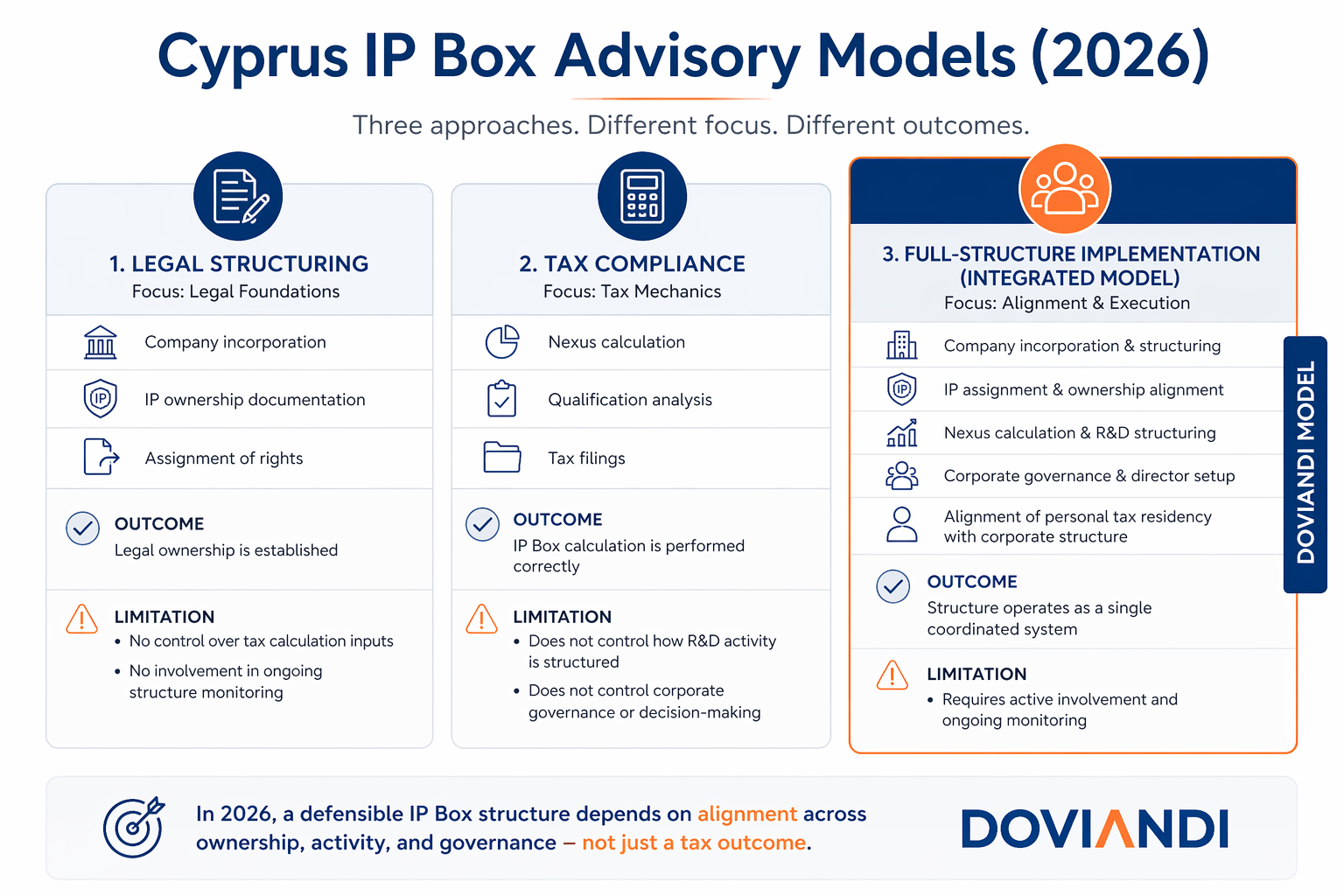
In 2026, implementing a Cyprus IP Box structure is not a single-step process. It requires coordination across company formation, IP ownership, tax calculation, and corporate governance.
For founders and shareholder-directors, the outcome depends on whether these elements are aligned in practice — not whether they exist individually.
This raises a practical question:
What type of advisory is required to implement and maintain a defensible Cyprus IP Box structure?
1. The Three Advisory Models in Practice
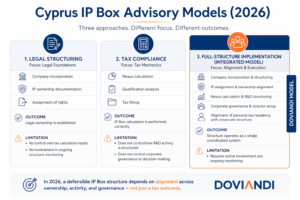
Cyprus IP Box advisory typically operates across three distinct models.
Model 1: Legal Structuring
Scope
- Company incorporation
- IP ownership documentation
- Assignment of rights
Outcome
- Legal ownership is established
Limitation
- No control over tax calculation inputs
- No involvement in ongoing structure monitoring
Model 2: Tax Calculation and Compliance
Scope
- Nexus calculation
- Qualification analysis
- Tax filings
Outcome
- IP Box calculation is performed correctly
Limitation
- Does not control how R&D activity is structured
- Does not control corporate governance or decision-making
Model 3: Full-Structure Implementation (Integrated Model)
Scope
- Company incorporation and structuring
- IP assignment and ownership alignment
- Nexus calculation and R&D structuring
- Corporate governance and director setup
- Alignment of personal tax residency with corporate structure
Outcome
- Structure operates as a single coordinated system
Limitation
- Requires active involvement and ongoing monitoring
2. Decision Logic (2026 Application)
The appropriate model depends on the objective.
| Objective | Model Typically Applied |
|---|---|
| Establish IP ownership | Legal structuring |
| Calculate tax exposure | Tax compliance |
| Implement a defensible structure | Full-structure implementation |
For founders operating SaaS, AI, or cross-border IP models, the third model is typically required.
3. Where Cyprus IP Box Structures Fail
The framework follows the OECD Modified Nexus Approach under BEPS Action 5, which links tax benefits directly to qualifying R&D activity. In practice, structures are challenged based on how they operate, not how they were designed.
3.1 Expenditure Misalignment
- Qualifying Expenditure (QE) not supported by actual R&D activity
- Incorrect classification of costs
To understand how expenditure classification directly affects the outcome, see our detailed breakdown and model the calculation directly using the Cyprus IP Box calculator.
3.2 Nexus Weakness
- Limited internal or third-party R&D
- High acquisition cost relative to development activity
For a detailed technical breakdown of how the Nexus fraction is calculated and what qualifies as expenditure, see this comprehensive guide to the Cyprus IP Box Nexus Fraction
3.3 Management and Control
- Strategic decisions taken outside Cyprus
- Directors not aligned with actual control
3.4 Residency Conflicts
- Personal tax residency not aligned with corporate structure
- Exposure under Double Tax Treaty tie-breaker rules
For a numerical illustration of how these variables interact see a worked example of the Cyprus IP Box calculation with real numbers.
4. The 2026 Structural Requirements
A Cyprus IP Box structure is assessed across three layers:
| Layer | Requirement |
|---|---|
| Personal | Cyprus tax residency supported by facts |
| Corporate | Management and control exercised in Cyprus |
| Functional | R&D activity supporting the Nexus calculation |
Failure in any layer affects the overall position.
For a full technical overview of how these layers interact within the Cyprus IP Box regime, see the full Cyprus IP Box 2026 technical guide.
5. Implementation vs. Ongoing Operation
A common issue is treating the structure as complete once implemented.
In practice:
- R&D activity evolves
- expenditure profiles change
- decision-making shifts
As a result, qualification under the IP Box must be maintained continuously.
6. Role of Advisory in Practice
At the implementation level, the distinction between advisory models becomes operational.
Full-structure implementation typically includes:
- incorporation of the Cyprus company
- structuring of IP ownership and assignment
- setup of directors and governance framework
- alignment of R&D activity with qualifying expenditure rules
- coordination of personal tax residency with corporate structure
- maintenance of documentation supporting management and control
7. Positioning of Doviandi
Doviandi operates within the full-structure implementation model, focusing on aligning IP ownership, R&D activity, and corporate governance into a single defensible system.
This includes:
- incorporation and structuring of Cyprus companies
- setup of local governance, including director framework
- structuring IP assignments, including contribution in kind where applicable
- aligning R&D activity with Nexus requirements
- coordinating personal tax residency with the corporate position
- maintaining documentation required for audit and cross-border review
The focus is on ensuring that:
- the structure is correctly implemented
- the structure remains consistent over time
- the position is defensible under review
For a practical explanation of how these elements are implemented in real setups, see how Cyprus IP Box structures are implemented in practice.
Final Observation
In 2026, the Cyprus IP Box is not defined by a fixed tax outcome.
It is determined by three operational factors:
- how ownership is structured
- how activity is performed
- how decisions are made
The advisory model determines whether these elements are aligned and defensible.
FAQ: Cyprus IP Box Advisory (2026)
What are the three types of Cyprus IP Box advisors?
Cyprus IP Box advisory typically falls into three models: legal structuring, tax compliance, and full-structure implementation. Each model focuses on a different layer of the structure.
Which type of advisor is required for SaaS founders?
For SaaS and technology founders, a full-structure implementation model is typically required, as it aligns IP ownership, R&D activity, and tax residency.
What does a Cyprus IP Box advisor actually do?
Depending on the model, advisory may include company incorporation, IP assignment, Nexus calculation, governance setup, and ongoing monitoring of the structure.
Can a Cyprus IP Box structure fail after setup?
Yes. Structures are typically challenged where expenditure does not support the Nexus calculation, or where management and control is not exercised in Cyprus.


