Following the January 1, 2026 Cyprus tax reform, which increased the standard corporate tax rate to 15%, Cyprus has increasingly become a jurisdiction considered by SaaS, AI, and digital IP-driven businesses operating internationally.
In practice, however, operating a Cyprus SaaS or AI company involves substantially more than company incorporation or access to the Cyprus IP Box regime.
For founder-led SaaS and AI companies, the position is generally evaluated based on how ownership, governance, development activity, and tax residency operate together over time.
This framework is particularly relevant for:
-
SaaS businesses
-
AI and machine-learning companies
-
API and infrastructure providers
-
Software licensing businesses
-
Remote-first development teams
-
Founder-led intellectual property structures
A Cyprus SaaS or AI company does not become qualifying merely because it is incorporated in Cyprus or holds intellectual property formally. Qualification depends on the interaction between ownership, development activity, expenditure classification, and management and control over time.
1. The Three-Layer Operational Model
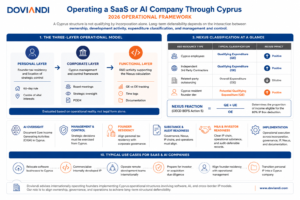
In practice, SaaS and AI companies operating through Cyprus are typically assessed across three interconnected operational layers.
| Layer | Operational Focus | Typical Review Area |
| Personal | Founder tax residency and location of strategic control | 60-day rule; centre of vital interests |
| Corporate | Cyprus management and control framework | Board meetings; strategic oversight; POEM |
| Functional | R&D activity supporting the Nexus calculation | QE vs OE expenditure tracking |
The structure is generally evaluated based on operational reality rather than legal form alone. For a broader overview of how these layers interact within the Cyprus IP Box framework, see our guide on relocating personally held IP to Cyprus.
2. Why SaaS and AI Companies Use Cyprus
Cyprus structures are commonly considered where businesses involve:
- internally developed software
- subscription-based SaaS revenue
- AI model development
- proprietary algorithms.
- licensed software infrastructure
- cross-border digital operations
Under the Cyprus IP Box regime, qualifying companies may access an 80% deduction on qualifying profit derived from qualifying intangible assets.
The framework follows the OECD Modified Nexus Approach under BEPS Action 5, linking the benefit directly to qualifying development activity rather than ownership alone.
3. Remote Development Teams and the Nexus Fraction
Many SaaS and AI businesses operate with developers located across multiple jurisdictions. Under the Cyprus IP Box regime for software and AI companies, the location of the developer is generally less important than:
- the legal relationship
- the classification of expenditure
- the level of operational oversight
- the structure of the development activity
Typical Nexus Treatment
| R&D Resource Type | Typical Classification | Nexus Impact |
| Cyprus employees | Qualifying Expenditure (QE) | Positive |
| Independent 3rd Party Contractors | Qualifying Expenditure (QE) | Positive |
| Related-party outsourcing | Overall Expenditure (OE) | Dilutive |
| Cyprus-resident founder dev | Potential QE | Positive |
As a result, contractor structuring and development oversight directly affect the Nexus fraction.
For a technical breakdown of how QE, Overall Expenditure (OE), and Uplift Expenditure (UE) interact, refer to our guide on the Cyprus IP Box Nexus Fraction. You can also model different expenditure scenarios using the Cyprus IP Box Calculator.
4. AI-Specific Operational Considerations
For AI and machine-learning businesses, authorities increasingly distinguish between:
- ownership of the model
- execution of development work
- operational oversight of technical activity.
In practice, operational defensibility may depend on documenting the Core Income Generating Activities (CIGA) connected to the Cyprus company.
This may include:
-
Architectural decision-making
-
Model deployment oversight
-
Inference system optimisation
-
Approval workflows
-
Strategic R&D direction
-
Technical sign-off procedures
Operational documentation often becomes the primary evidence demonstrating alignment between the Cyprus company and the underlying development activity.
5. Management and Control in Practice
For internationally operating SaaS and AI founders, management and control is often one of the most scrutinised aspects of the Cyprus company. Authorities may examine where strategic decisions are made, who exercises operational control, and the location of directors.
A Cyprus company is generally expected to demonstrate that strategic management is exercised from Cyprus rather than merely documented there. Where founder residency and operational activity remain substantially connected to another jurisdiction, Double Tax Treaty tie-breaker rules may become relevant.
6. Founder Relocation and Residency Alignment
For founder-led SaaS and AI businesses, personal tax residency and the Cyprus operating company are often interconnected. In practice, structures may involve relocation under the Cyprus 60-day rule together with local governance frameworks and the relocation of strategic oversight. Where residency positions conflict across jurisdictions, authorities may examine the centre of vital interests and the operational decision-making location.
7. Operational Substance and Audit Readiness
In practice, SaaS and AI companies are generally assessed based on whether the operational profile supports the legal structure.
| Area | Common Challenge |
| Governance | Strategic decisions exercised outside Cyprus |
| Nexus | Misclassification of related-party expenditure |
| IP Ownership | Incomplete assignment documentation |
| Operations | Disconnect between legal structure and actual conduct |
For a worked numerical example of how the Nexus calculation operates in practice, see our detailed calculation example.
8. M&A and Investor Readiness
SaaS and AI companies may eventually become subject to investor or acquisition due diligence. Review processes commonly examine the ownership of intellectual property, contractor assignment chains, and historical Nexus calculations. As a result, structures are frequently implemented with long-term operational defensibility in mind rather than purely annual tax compliance.
9. Implementation in Practice
For SaaS and AI founders operating internationally, implementation generally involves coordination across incorporation, governance frameworks, IP ownership structuring, and Nexus modelling. This process is operational rather than purely administrative in nature.
Firms such as Doviandi operate within this implementation layer for SaaS, AI, and IP-driven businesses using Cyprus structures.
10. Typical Use Cases
In practice, Cyprus SaaS and AI structures are commonly implemented where founders:
- relocate software businesses to Cyprus
- commercialise internally developed IP
- operate remote development teams internationally
- prepare for investor or acquisition due diligence
- align founder residency with operational management
- transition personally held intellectual property into a Cyprus company
These structures are typically operational in nature and require coordination across legal ownership, governance, development activity, and tax positioning.
Final Observation
Operating a SaaS or AI company through Cyprus is operational rather than formulaic.
Qualification under the Cyprus IP Box regime depends on the interaction between intellectual property ownership, development activity, expenditure classification, management and control, and the founder residency position.
As a result, the long-term defensibility of the structure depends less on incorporation itself and more on whether the operational profile supports the underlying tax position.
Businesses operating SaaS, AI, or IP-driven models through Cyprus generally require coordination across incorporation, governance, Nexus alignment, and founder residency planning.
Doviandi advises internationally operating founders implementing Cyprus operational structures involving software, AI, and cross-border intellectual property models.