Cyprus Holding Company in 2026
Cyprus remains one of the most widely used European jurisdictions for international holding company structures, particularly for SaaS companies, AI businesses, investment groups, cross-border founders and internationally scaling corporate groups seeking an EU-based platform for ownership, governance and exit planning.
Following the January 1, 2026 Cyprus tax reform, the Cyprus holding company framework evolved significantly. While the standard Cyprus corporate income tax rate increased from 12.5% to 15% in alignment with broader OECD Pillar Two developments, the core advantages of Cyprus holding structures remained largely intact for international operators.
For properly structured groups, Cyprus continues to provide:
- participation exemption treatment for qualifying dividends,
- 0% capital gains tax on qualifying securities,
- broad treaty access,
- EU legal certainty,
- flexible outbound dividend treatment,
- and operational compatibility with modern founder and investment structures.
For international founders and investors, the value of a Cyprus holding company is no longer simply low taxation. The modern Cyprus framework is increasingly centered around governance quality, treaty access, operational substance, cross-border flexibility and long-term exit efficiency.
This guide explains:
- how Cyprus holding companies work,
- how participation exemptions operate,
- the impact of the 2026 Cyprus tax reform,
- outbound dividend withholding tax rules,
- transfer pricing developments,
- the property-rich company rules,
- substance and anti-avoidance considerations,
- and how international founders typically structure Cyprus holding platforms.
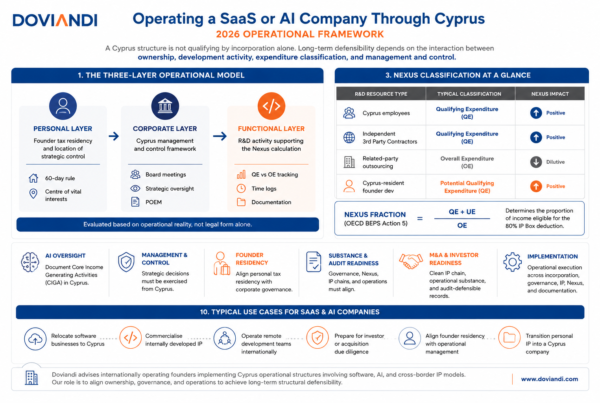
For broader founder and operational structuring analysis, see our Cyprus SaaS & AI Company Structures framework.
For intellectual property planning, see our Cyprus IP Box Guide (2026).
This guide focuses specifically on Cyprus holding companies. Founders evaluating where to incorporate, how to structure ownership and how holding companies interact with IP, tax residency and exit planning should first read the International Founder Operating Manual.
1. What is a Cyprus holding company?
A Cyprus holding company is typically used as an intermediate or parent entity that owns shares, intellectual property, financing assets or operational subsidiaries in other jurisdictions.
In practice, Cyprus holding companies are commonly used by:
- SaaS and AI founders,
- venture-backed technology groups,
- private equity structures,
- family offices,
- international investment platforms,
- cross-border consulting and service groups,
- and multinational operational structures seeking an EU corporate platform.
The core utility of a Cyprus holding company is primarily driven by the Cyprus participation exemption framework and the favorable treatment of qualifying securities.
Under the Cyprus Income Tax Law, qualifying dividend income received by a Cyprus company may generally be exempt from Cyprus corporate income tax, while gains arising from the disposal of qualifying securities are generally exempt from capital gains taxation, subject to specific anti-avoidance and Cyprus real estate provisions.
The participation exemption framework is codified under Article 8(22) of the Cyprus Income Tax Law, with administrative guidance and circulars issued periodically by the Cyprus Tax Department through the Cyprus Ministry of Finance.
2. Core tax features of a Cyprus holding company
The modern Cyprus holding company framework continues to attract international groups because several key structural advantages remain available under the post-2026 tax system.
| Cyprus Holding Company Feature | Practical Impact |
|---|---|
| Participation exemption on qualifying dividends | Inbound qualifying dividends are generally exempt from Cyprus corporate income tax |
| 0% capital gains tax on qualifying securities | Share disposals and exits are generally exempt unless Cyprus real estate rules apply |
| EU legal framework | Access to EU directives and institutional compatibility |
| Extensive double tax treaty network | Broad international treaty access |
| No withholding tax on many outbound dividend payments to individuals | Efficient founder extraction planning |
| Flexible cross-border structuring | Widely used for investment and operational platforms |
| OECD-aligned tax framework | Alignment with international substance and anti-avoidance standards |
In practice, Cyprus is frequently selected not because it is the lowest-tax jurisdiction globally, but because it combines tax efficiency with institutional credibility, treaty access and operational flexibility.
3. Key Cyprus tax reform changes affecting holding companies (2026)
The January 1, 2026 Cyprus tax reform introduced several changes directly affecting international holding company structures.
Corporate tax increase to 15%
The Cyprus corporate income tax rate increased from 12.5% to 15% as part of broader alignment with OECD Pillar Two and international minimum tax developments.
For pure holding company structures, however, the practical impact is often limited because:
- qualifying dividends generally remain exempt,
- gains on qualifying securities generally remain exempt,
- and many holding structures derive limited taxable operational income at the holding layer itself.
Abolition of Deemed Dividend Distribution (DDD)
The abolition of the Deemed Dividend Distribution (DDD) framework primarily affects Cyprus tax-resident and Cyprus-domiciled shareholders.
For most international founders and Non-Dom structures, DDD historically carried limited practical impact because non-domiciled shareholders were generally exempt from Special Defence Contribution (SDC) liabilities.
However, the removal of DDD significantly simplifies corporate reserve management and reduces certain trailing General Healthcare System (GHS) exposures for Cyprus tax-resident Non-Doms.
Full abolition of Cyprus stamp duty
The 2026 reform also abolished Cyprus stamp duty entirely.
This materially reduces transactional friction for:
- shareholder agreements,
- financing documentation,
- intercompany loan arrangements,
- restructuring exercises,
- trust documentation,
- and investment transactions.
Extended loss carry-forward period
Corporate tax losses may now generally be carried forward for up to 7 years instead of 5 years.
For venture-backed technology groups and scaling operational structures, this significantly improves long-term fiscal buffering during heavy R&D or pre-profitability phases.
4. Participation exemption and qualifying securities
Under the Cyprus participation exemption framework, inbound dividend distributions received by a Cyprus holding company are generally exempt from Cyprus corporate income tax, subject to anti-avoidance and structural considerations.
Similarly, gains arising from the disposal of qualifying securities are generally exempt from capital gains taxation.
Qualifying securities may include:
- ordinary shares,
- preference shares,
- founders’ shares,
- bonds,
- debentures,
- options,
- and other qualifying financial instruments.
For internationally scaling SaaS companies, AI businesses and investment groups, this framework creates substantial flexibility for:
- group reorganizations,
- investment holding structures,
- acquisition platforms,
- founder exits,
- and long-term reinvestment strategies.
In practical terms, a Cyprus holding company can often receive dividend flows from operational subsidiaries, retain earnings, reinvest capital and potentially dispose of qualifying subsidiaries without triggering Cyprus taxation at the intermediate holding layer.
5. Outbound dividend withholding tax rules (2026)
Following the 2026 Cyprus tax reform, outbound withholding tax rules became more targeted and defensive in nature.
Cyprus generally continues to impose no withholding tax on outbound dividends paid to individual shareholders, including many international founders operating through Cyprus holding structures.
However, defensive withholding tax rules now apply in certain situations involving corporate recipients located in low-tax or EU-blacklisted jurisdictions.
In simplified terms:
| Outbound Dividend Scenario | Indicative Cyprus WHT Treatment |
|---|---|
| Dividends paid to many individual shareholders | Generally 0% withholding tax |
| Dividends paid to associated corporate entities in low-tax jurisdictions | 5% withholding tax may apply |
| Payments involving EU-blacklisted jurisdictions or anti-avoidance triggers | 17% withholding tax may apply |
The practical outcome is that properly structured Cyprus holding companies with genuine operational substance and commercially rational ownership structures continue to remain highly efficient for international founder and investment platforms.
6. Transfer pricing and governance developments
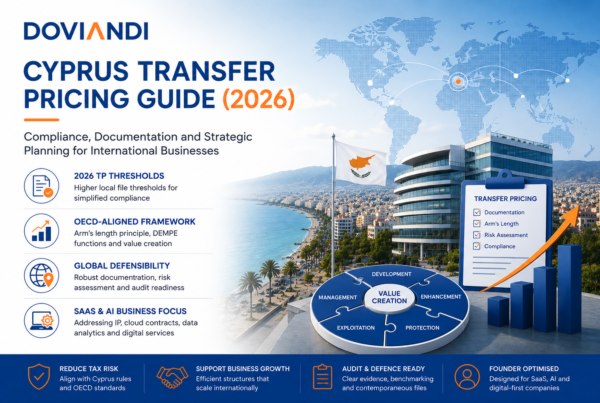
The 2026 reforms also significantly modernized the Cyprus transfer pricing environment.
One of the most important developments for international holding structures was the increase in local file thresholds for related-party transactions.
Broadly speaking:
| Transaction Category | Approximate Local File Threshold |
|---|---|
| Financing transactions | €10 million |
| Sale of goods | €5 million |
| Other transaction categories | €2.5 million |
For intermediate holding companies, financing platforms and investment structures, these higher thresholds substantially reduce compliance friction for smaller and mid-sized groups.
Nevertheless, Cyprus transfer pricing rules remain highly relevant for:
- intercompany financing,
- management services,
- royalty arrangements,
- licensing structures,
- and asset transfers between related entities.
For transfer pricing analysis and documentation strategy, see our Cyprus Transfer Pricing Guide.
7. The property-rich company rules and exit planning
Under the post-2026 Cyprus framework, the threshold for classifying a corporate entity as a property-rich company for Cyprus Capital Gains Tax purposes was significantly tightened.
Historically, shares in a company were generally subject to Cyprus Capital Gains Tax only where 50% or more of the underlying asset value was derived from Cyprus immovable property.
Effective January 1, 2026, this threshold was reduced to 20%.
This applies both to:
- direct holdings of Cyprus immovable property,
- and indirect holdings through layered corporate structures.
The reform also introduced stronger fair market value anti-undervaluation rules when disposing of shares in property-rich companies.
For technology groups, investment platforms and operational holding structures, maintaining real estate exposure below the 20% threshold may therefore become important to preserve the broader 0% capital gains positioning available for qualifying securities.
This is particularly relevant for groups acquiring:
- local office infrastructure,
- operational premises,
- commercial development assets,
- or real estate-heavy operational subsidiaries.
8. Cyprus holding company vs alternative international jurisdictions
International founders and investment groups commonly evaluate Cyprus against alternative holding company jurisdictions.
The post-2026 environment highlights several structural distinctions.
| Jurisdiction | Participation Exemption on Dividends | Capital Gains on Share Exit | Key Structural Consideration |
|---|---|---|---|
| Cyprus | Generally exempt | Generally exempt if Cyprus real estate exposure remains below 20% | EU compatibility, founder-friendly outbound treatment, treaty access and operational flexibility |
| UAE | Available subject to conditions | Available subject to participation rules | Increasing substance and transfer pricing scrutiny |
| Estonia | 0% on retained earnings | 0% while retained | Distribution tax triggered upon shareholder extraction |
| Ireland | Available through more complex rules | Often available subject to conditions | Higher operational and compliance costs |
For SaaS founders, investment groups and internationally scaling structures, Cyprus is often evaluated as a middle ground between institutional credibility, operational flexibility and tax efficiency.
9. Substance, anti-avoidance and governance considerations
The effectiveness of a Cyprus holding company structure depends heavily on operational substance, governance quality and commercial rationale.
International tax authorities increasingly evaluate:
- strategic decision-making,
- board control,
- transfer pricing alignment,
- beneficial ownership,
- economic substance,
- and the practical location of management functions.
Cyprus structures designed for international groups should therefore operate as genuine governance and ownership platforms rather than passive nominee arrangements.
Proper documentation, board procedures, transfer pricing support, intercompany agreements and commercial consistency are essential to sustaining long-term tax efficiency and treaty access.
The 2026 reforms also strengthened anti-avoidance provisions targeting disguised distributions, below-market transactions and the private use of corporate assets.
Accordingly, governance discipline has become increasingly important for founder-led and closely held structures.
10. Typical use cases for Cyprus holding companies
Cyprus holding companies are frequently used for:
- international SaaS and AI group structures,
- venture-backed startup ownership platforms,
- intellectual property ownership chains,
- regional investment platforms,
- acquisition and M&A structures,
- family office structures,
- and founder exit planning.
For founders combining operational companies with intellectual property ownership, the interaction between:
- the Cyprus IP Box regime,
- participation exemptions,
- transfer pricing,
- operational substance,
- and personal tax residency
often becomes more important than headline tax rates alone.
See also:
- Cyprus IP Box Guide (2026)
- Cyprus Non-Dom & 60-Day Rule Guide
- Cyprus Company Formation Guide for SaaS & AI Businesses
11. FAQ — Cyprus holding companies (2026)
What is a Cyprus holding company?
A Cyprus holding company is typically used as a parent or intermediate entity holding shares, intellectual property or investments in operational subsidiaries.
Are dividends received by a Cyprus holding company taxable?
Qualifying dividends are generally exempt from Cyprus corporate income tax under the participation exemption framework.
Does Cyprus charge capital gains tax on the sale of shares?
Gains arising from qualifying securities are generally exempt unless Cyprus immovable property exposure exceeds the relevant thresholds.
What is the property-rich company threshold in Cyprus?
From January 1, 2026 onward, a company may be treated as property-rich where Cyprus immovable property represents 20% or more of underlying asset value.
Does Cyprus impose withholding tax on outbound dividends?
Cyprus generally imposes no withholding tax on outbound dividends paid to many individual shareholders, although defensive withholding tax rules may apply to certain corporate recipients in low-tax or blacklisted jurisdictions.
Is Cyprus compliant with OECD standards?
Yes. Cyprus operates within OECD and EU frameworks and applies substance, transfer pricing and anti-avoidance rules consistent with international standards.
Do SaaS and AI companies use Cyprus holding structures?
Yes. Cyprus is widely used by SaaS companies, AI businesses and internationally scaling technology groups for operational holding, investment and IP ownership structures.
12. How Doviandi helps
Doviandi advises founders, technology groups, investment structures and international businesses on:
- Cyprus holding company structuring,
- cross-border ownership planning,
- participation exemption analysis,
- transfer pricing,
- IP structuring,
- governance and substance planning,
- Cyprus company formation,
- and operational implementation.
For tailored structuring support:
Contact Doviandi

Final observations
The Cyprus holding company framework remains one of the most internationally flexible and institutionally credible structures available within the European Union for founders, investors and internationally scaling groups.
The post-2026 environment places greater emphasis on:
- governance,
- operational substance,
- transfer pricing discipline,
- and commercially rational structuring.
For SaaS businesses, AI companies, investment groups and founder-led international structures, early planning and coherent implementation generally produce significantly stronger long-term outcomes than attempting to retrofit governance or substance later.
Author: Chris Parpas BFP FCA ICPAC, Managing Director at Doviandi
This article was published in May 2026 to reflect the Cyprus tax reforms effective from 1 January 2026, including changes affecting holding companies, transfer pricing thresholds and outbound withholding tax rules.
Disclaimer: For informational purposes only. Does not constitute tax or legal advice.