Cyprus Non-Dom status in 2026
Cyprus has become one of the most strategically important personal tax residency jurisdictions for internationally mobile founders, SaaS operators, investors, consultants, holding company owners and AI entrepreneurs seeking an EU-based structure with legally efficient dividend extraction and internationally recognized tax residency status.
The modern Cyprus Non-Dom framework combines:
- EU tax residency credibility
- 0% tax on most dividend income for Non-Doms
- 0% tax on most foreign interest income
- access to the Cyprus 60-day tax residency rule
- extensive double tax treaty coverage
- operational compatibility with Cyprus holding companies and IP structures
- relatively low physical presence requirements compared to many competing jurisdictions
Following the January 1, 2026 Cyprus tax reform, the Cyprus residency framework became significantly more flexible for international founders and cross-border business operators.
Most importantly, the restrictive “exclusive tax residency” condition connected to the 60-day rule was removed, fundamentally modernizing Cyprus residency planning for globally mobile entrepreneurs.
This guide explains:
- how Cyprus Non-Dom status works,
- how the Cyprus 60-day tax residency rule operates after the 2026 reform,
- how founders combine Cyprus residency with holding companies and IP structures,
- how dividends are taxed,
- how treaty tie-breaker rules function,
- how SaaS and AI founders typically structure personal extraction,
- and the documentation required to sustain an internationally defensible residency position.
For related corporate structuring analysis, see:
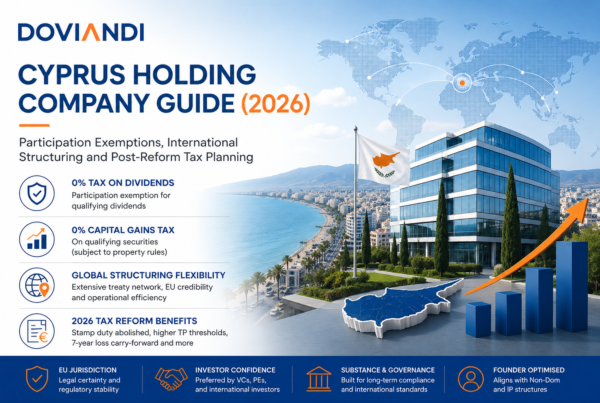
- Cyprus Holding Company Guide (2026)
- Cyprus IP Box Guide (2026)
- Cyprus Transfer Pricing Guide (2026)
- Cyprus SaaS & AI Company Structures (2026)
Personal tax residency should not be considered in isolation. It forms part of the broader international structuring framework explained in the International Founder Operating Manual.
1. What is Cyprus Non-Dom status?
Cyprus Non-Dom status is a personal tax classification available to Cyprus tax residents who are not considered domiciled in Cyprus for Special Defence Contribution (SDC) purposes.
In practice, this means qualifying individuals may legally receive:
- dividends free from Cyprus dividend tax (SDC),
- most foreign interest income free from Cyprus tax,
- and certain investment income without additional Cyprus defensive taxation.
For international founders, this creates a highly efficient alignment between:
- corporate profit accumulation,
- holding company structuring,
- and personal dividend extraction.
Importantly, Cyprus Non-Dom status is separate from corporate tax residency.
A founder may simultaneously:
- own a Cyprus holding company,
- operate a Cyprus IP company,
- manage international subsidiaries,
- and maintain Cyprus personal tax residency under the Non-Dom framework.
2. The Cyprus 60-day tax residency rule (post-2026 framework)
The Cyprus 60-day rule is one of the most internationally discussed tax residency frameworks because it allows individuals to become Cyprus tax residents without spending most of the year in Cyprus.
Under the post-2026 framework, an individual may generally qualify as Cyprus tax resident where they:
| Requirement | Summary |
|---|---|
| Physical presence | Spend at least 60 days in Cyprus during the tax year |
| Non-residency elsewhere | Are not tax resident in another jurisdiction under conflicting domestic rules or treaty outcomes |
| Cyprus economic connection | Maintain business activity, employment, directorship or office in Cyprus |
| Permanent residential link | Maintain owned or rented accommodation in Cyprus |
| Ongoing connection | Preserve sufficient factual connection to Cyprus during the year |
The critical modernization introduced from January 1, 2026 is that the historical “exclusive tax residency” restriction was removed.
Prior to the reform, individuals were generally required to prove they were not tax resident anywhere else in the world.
Under the modernized framework, dual-residency situations may now instead be resolved through applicable double tax treaty tie-breaker provisions, including:
- center of vital interests,
- habitual abode,
- permanent home,
- and nationality tests.
This dramatically improved the usability of Cyprus residency for internationally mobile founders operating across multiple jurisdictions.
Official Cyprus guidance can be found at the Ministry of Finance website.
3. Why international founders use Cyprus Non-Dom structures
The Cyprus Non-Dom framework is increasingly used by:
- SaaS founders,
- AI and machine learning entrepreneurs,
- digital agency owners,
- private equity participants,
- consultants and international advisors,
- crypto and fintech operators,
- remote-first software teams,
- and internationally distributed engineering groups.
The appeal is not simply low tax.
The strategic advantage is the interaction between:
- EU-recognized tax residency,
- dividend-based extraction,
- holding company structures,
- participation exemptions,
- IP ownership,
- and treaty-supported cross-border positioning.
For internationally scaling founders, Cyprus often functions as the “personal residency layer” sitting above:
- Cyprus holding companies,
- Cyprus IP Box structures,
- and international operating subsidiaries.
This allows founders to legally align:
- corporate taxation,
- asset ownership,
- personal residency,
- and long-term exit planning.
4. Dividend taxation under Cyprus Non-Dom status
One of the most important features of Cyprus Non-Dom status is the treatment of dividend income.
Under the Cyprus Non-Dom framework:
| Income Type | Typical Cyprus Tax Treatment for Non-Doms |
|---|---|
| Dividends | 0% SDC |
| Most foreign interest income | 0% SDC |
| Capital gains on qualifying securities | Generally exempt |
| Salary income | Subject to normal income tax bands |
| Rental income | Separate treatment may apply |
For internationally structured groups, this allows founders to extract profits from Cyprus holding companies without Cyprus dividend taxation under the SDC regime.
This is one of the reasons Cyprus is frequently evaluated against:
- UAE,
- Malta,
- Portugal,
- Italy,
- Estonia,
- and Switzerland.
However, founders must understand that Cyprus Non-Dom status does not override foreign anti-avoidance frameworks, controlled foreign company (CFC) rules or treaty residence analysis in other jurisdictions.
Substance and factual management remain critically important.
5. Cyprus holding companies and founder extraction strategies
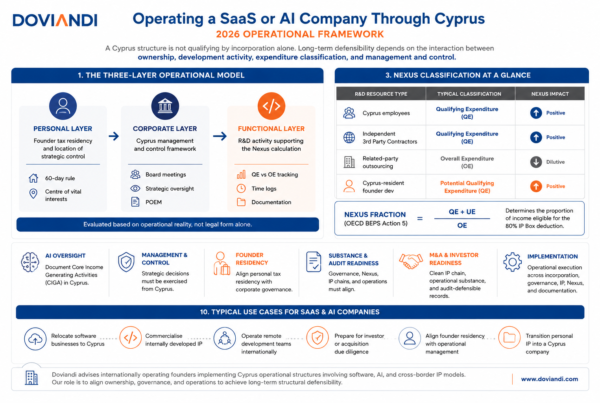
The modern Cyprus structure frequently used by international founders consists of multiple layers:
| Layer | Typical Function |
|---|---|
| Cyprus Holding Company | Asset ownership, dividends, exits |
| Cyprus IP Company | Software or IP commercialization |
| International Operating Subsidiaries | Local operations and revenue generation |
| Cyprus Non-Dom Founder | Dividend extraction and residency alignment |
This interaction between corporate structuring and personal residency is one of the core reasons Cyprus remains attractive for international founder infrastructure.
A typical structure may involve:
- software developed inside a Cyprus IP company,
- profits taxed under the Cyprus IP Box regime,
- excess profits distributed to a Cyprus holding company,
- and founder extraction via Non-Dom dividend treatment.
For further analysis see:
6. Substance, treaty residency and audit defensibility
One of the most misunderstood aspects of Cyprus residency planning is the concept of “substance.”
Substance is not limited to office leases or physical infrastructure.
For internationally mobile founders, substance is primarily demonstrated through:
- genuine strategic decision-making,
- factual management activity,
- economic alignment,
- and documentary evidence.
Key evidence typically includes:
- board minutes,
- director resolutions,
- travel records,
- Cyprus accommodation agreements,
- banking activity,
- payroll records,
- commercial agreements,
- tax residency certificates,
- utility evidence,
- and operational governance documentation.
For SaaS and AI businesses, substance is often misunderstood. It does not require physical servers or large offices in Cyprus. It requires digital governance: the ability to demonstrate that the Cyprus entity controls the development roadmap, owns the cloud-infrastructure contracts, and manages the commercial deployment of the AI or software product. In an audit, the DEMPE functions are proven via documented strategic board decisions, not just the physical location of code developers.
International founders should also understand that treaty residency analysis increasingly focuses on:
- place of effective management,
- beneficial ownership,
- DEMPE functions,
- and commercial rationale.
This is particularly important where founders maintain international operational footprints.
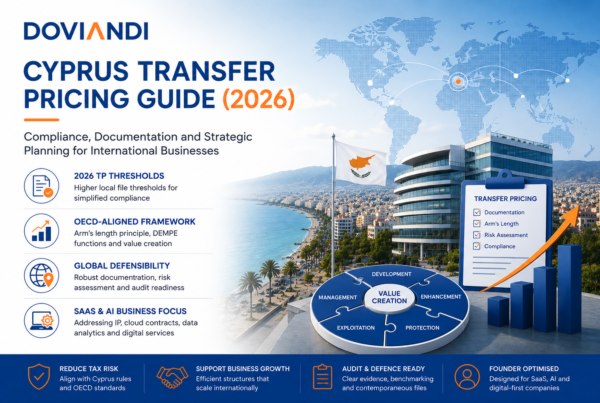
For transfer pricing and DEMPE analysis, see the Cyprus Transfer Pricing Guide.
7. Cyprus Non-Dom vs UAE vs Portugal vs Estonia
International founders frequently compare Cyprus against alternative residency jurisdictions.
The post-2026 framework highlights important structural differences:
| Jurisdiction | Dividend Tax Position | EU Residency | Key Strategic Observation |
|---|---|---|---|
| Cyprus | 0% SDC for Non-Doms | Yes | Strong treaty network, holding company compatibility and founder extraction efficiency |
| UAE | Often 0% personal tax | No | Increasing corporate substance and TP scrutiny |
| Portugal | Limited historical incentives remain | Yes | Regime significantly tightened in recent years |
| Estonia | Corporate deferral model | Yes | Efficient reinvestment system but distribution tax applies |
| Italy | Lump-sum regimes available | Yes | Higher complexity and operational costs |
For many founders, Cyprus now occupies a middle ground between:
- UAE-style extraction efficiency,
- and EU institutional credibility.
8. Common mistakes founders make
The most common Cyprus residency mistakes include:
- treating Cyprus as a purely “paper residency” jurisdiction,
- failing to document actual management activity,
- ignoring treaty tie-breaker analysis,
- using inconsistent travel records,
- misunderstanding Non-Dom qualification,
- failing to align corporate substance with personal residency,
- and implementing aggressive structures without transfer pricing support.
Modern international tax enforcement increasingly focuses on:
- commercial rationale,
- governance evidence,
- beneficial ownership,
- and operational consistency.
Good structuring is therefore documentation-driven, not marketing-driven.
9. Frequently asked questions (FAQ)
Is Cyprus Non-Dom status available to foreigners?
Yes. Cyprus Non-Dom status is commonly used by international founders, investors and professionals who become Cyprus tax residents without acquiring Cyprus domicile status.
How long does Cyprus Non-Dom status last?
Generally up to 17 years, subject to satisfying the relevant conditions.
Can I become Cyprus tax resident by spending only 60 days in Cyprus?
Potentially yes, provided the statutory conditions are satisfied and treaty residency outcomes support the structure.
Can I own a foreign company while being Cyprus tax resident?
Yes. Many founders own international operating companies while maintaining Cyprus personal tax residency.
Are dividends taxed in Cyprus for Non-Doms?
In many cases, dividends received by Cyprus Non-Doms are exempt from Special Defence Contribution (SDC).
Does Cyprus tax foreign income?
This depends on the nature of the income, source rules, treaty interaction and residency position.
Can I combine Cyprus Non-Dom status with a Cyprus holding company?
Yes. This is one of the most common international structuring models used by founders and investors.
Can SaaS and AI founders use Cyprus Non-Dom structures?
Yes. Cyprus is increasingly used by SaaS, AI and digital businesses operating internationally.
Does Cyprus have double tax treaties?
Yes. Cyprus maintains an extensive double tax treaty network.
Is Cyprus compliant with OECD and EU rules?
Yes. Cyprus operates within EU law and OECD-aligned frameworks.
10. How Doviandi helps
Doviandi advises founders, investors and international groups on:
- Cyprus tax residency structuring,
- Non-Dom applications,
- holding company structures,
- IP ownership frameworks,
- transfer pricing,
- operational substance,
- SaaS and AI founder structuring,
- cross-border governance,
- and internationally scalable Cyprus corporate infrastructure.
Related resources:
- Cyprus Holding Company Guide (2026)
- Cyprus IP Box Guide (2026)
- Cyprus Transfer Pricing Guide (2026)
- Cyprus Company Formation

Final observations
The Cyprus Non-Dom and 60-day residency framework is no longer simply a relocation tool.
Following the 2026 reforms, it has evolved into a modern international founder infrastructure framework connecting:
- personal residency,
- corporate ownership,
- dividend extraction,
- IP commercialization,
- holding company planning,
- and cross-border governance.
For SaaS founders, AI operators, investors and internationally mobile entrepreneurs, the interaction between personal residency and corporate architecture is often more important than headline tax rates alone.
Well-structured Cyprus residency planning is therefore not about “avoiding tax.”
It is about building a legally sustainable, treaty-aligned and operationally defensible international platform capable of supporting long-term business growth, investment activity and global mobility.
Author: Chris Parpas BFP FCA ICPAC, Managing Director at Doviandi
Disclaimer: This article is for informational purposes only and does not constitute tax or legal advice.