Cyprus transfer pricing in 2026
Transfer pricing has become one of the central issues in modern international structuring.
For SaaS companies, AI businesses, holding companies, investment platforms, engineering groups and internationally operating founder-led businesses, transfer pricing is no longer a niche compliance exercise. It is now one of the primary mechanisms through which tax authorities evaluate:
- whether profits are aligned with real economic activity,
- whether intellectual property structures are defensible,
- whether management and financing structures are commercially credible,
- and whether multinational groups are operating consistently with OECD principles.
New to international structuring? Transfer pricing is only one component of building a defensible cross-border business. For a complete overview of company formation, holding companies, founder tax residency, IP ownership, operational substance and exit planning, start with our International Founder Operating Manual.
Following the January 1, 2026 Cyprus tax reform framework, Cyprus has emerged as one of the most strategically attractive EU jurisdictions for internationally structured businesses because it combines:
- OECD-aligned transfer pricing rules,
- EU legal certainty,
- comparatively efficient operational costs,
- modern holding company infrastructure,
- robust intellectual property frameworks,
- and practical flexibility for distributed international teams.
At the same time, Cyprus transfer pricing enforcement has become significantly more sophisticated.
Businesses operating through Cyprus entities are increasingly expected to maintain:
- arm’s-length pricing support,
- functional analysis documentation,
- economic substance,
- intercompany agreements,
- benchmarking support,
- and commercially rational allocation of profits.
This guide explains:
- how Cyprus transfer pricing rules operate,
- when transfer pricing documentation is required,
- the 2026 documentation thresholds,
- how SaaS and AI companies are commonly structured,
- how holding companies and IP structures are reviewed,
- how financing arrangements are evaluated,
- and how founders can build defensible, audit-ready structures.
For broader analysis of international founder structuring and operational frameworks, see:
- Cyprus Holding Company Guide (2026)
- Cyprus IP Box Guide (2026)
- Cyprus SaaS & AI Company Structures (2026)
- Cyprus Non-Dom & 60-Day Residency Guide (2026)
1. What is transfer pricing?
Transfer pricing refers to the pricing of transactions between related parties.
These transactions may include:
- management fees,
- software licensing,
- intellectual property royalties,
- intercompany financing,
- cost sharing,
- technical services,
- contractor recharges,
- platform access,
- engineering support,
- and cross-border operational allocations.
Cyprus transfer pricing rules are based primarily on the OECD Arm’s Length Principle.
This means that related-party transactions should be priced as if the parties were independent commercial enterprises negotiating under normal market conditions.
The core principle is simple:
profits should follow real functions, risks and economic activity.
This principle has become central to:
- OECD BEPS implementation,
- Pillar Two global tax alignment,
- cross-border audit activity,
- and modern international tax enforcement.
OECD transfer pricing guidance
2. Cyprus transfer pricing rules — the legal framework
Cyprus formally introduced comprehensive transfer pricing legislation through Articles 33 and 33A of the Cyprus Income Tax Law.
The framework aligns Cyprus with:
- OECD Transfer Pricing Guidelines,
- OECD BEPS Action Plans,
- EU anti-avoidance standards,
- and international documentation requirements.
The Cyprus framework applies broadly to:
- Cyprus companies,
- permanent establishments,
- international group structures,
- holding companies,
- IP companies,
- financing companies,
- and cross-border operational entities.
The rules generally apply whenever related parties transact with one another.
This includes both:
- domestic related-party transactions,
- and international related-party transactions.
The Cyprus Tax Department may adjust taxable profits where intercompany pricing does not reflect arm’s-length conditions.
In practice, transfer pricing has become one of the primary audit areas for:
- intellectual property structures,
- management fee arrangements,
- founder-controlled groups,
- financing structures,
- and international holding company platforms.
3. 2026 Cyprus transfer pricing thresholds — one of the most important reforms for international groups
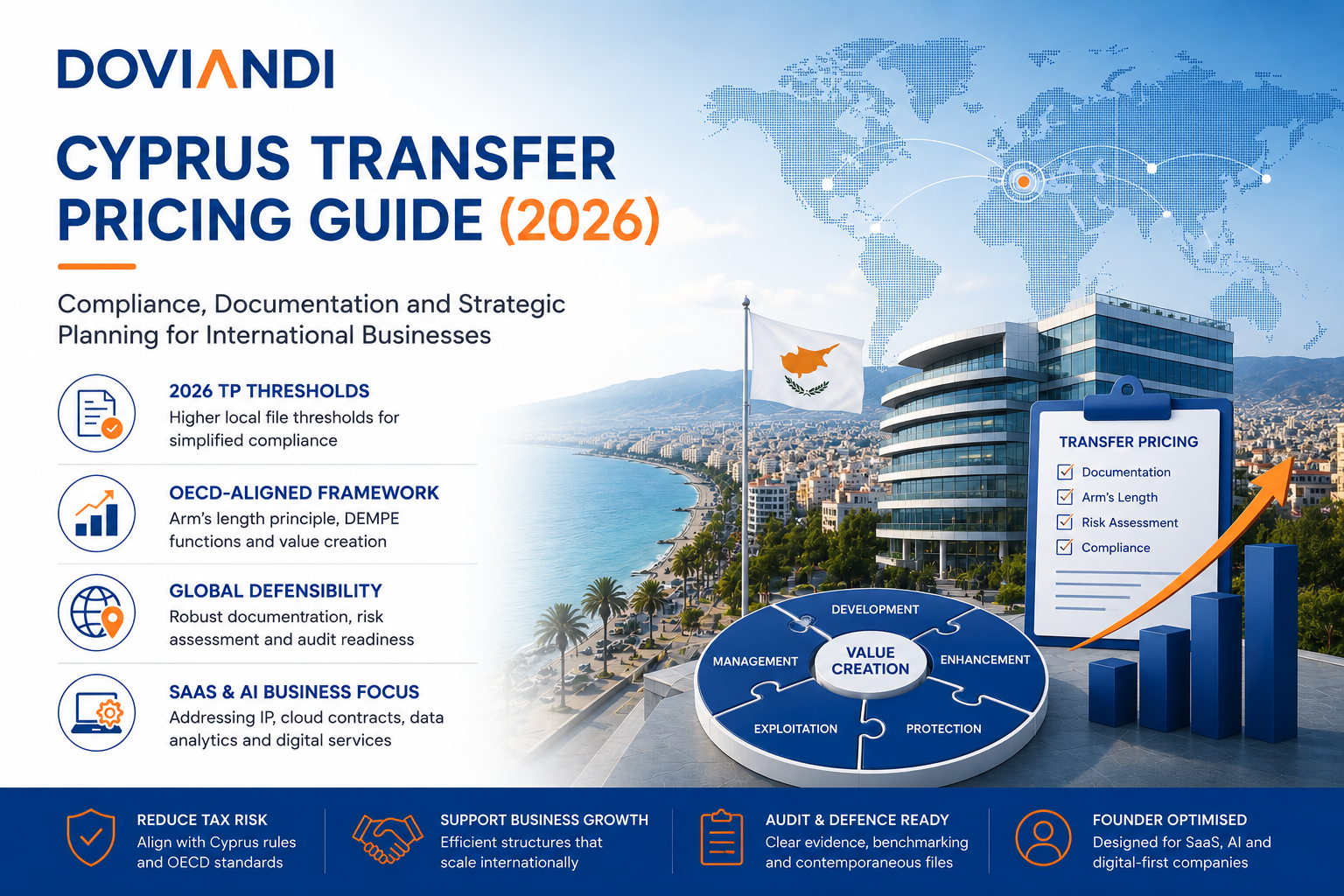
One of the most commercially important changes introduced under the post-2026 framework was the significant increase in local file documentation thresholds.
This substantially reduced compliance burdens for many international founder-led groups and intermediate holding structures.
Cyprus Transfer Pricing Local File Thresholds (2026)
| Transaction Category | Local File Requirement Threshold |
|---|---|
| Financing transactions | €10 million |
| Sale of goods transactions | €5 million |
| All other categories (services, IP licensing, management fees etc.) | €2.5 million |
This means that many early-stage and mid-market international businesses may no longer require full Cyprus Local File preparation where transaction volumes remain below the applicable thresholds.
However, this does NOT eliminate the arm’s-length requirement.
Even where Local Files are not mandatory, businesses should still maintain:
- intercompany agreements,
- commercial rationale,
- pricing support,
- benchmarking logic,
- board approvals,
- and substance documentation.
This distinction is critical.
Many founders incorrectly assume that falling below the thresholds removes transfer pricing risk entirely.
It does not.
The Cyprus Tax Department may still review whether:
- pricing is commercially rational,
- profits align with real activity,
- and transactions reflect genuine economic substance.
4. Why transfer pricing matters for SaaS, AI and IP structures
Transfer pricing is especially important for:
- SaaS companies,
- AI businesses,
- software development groups,
- API businesses,
- platform companies,
- engineering groups,
- and IP holding structures.
Why?
Because modern technology businesses frequently operate through distributed international teams.
A typical international SaaS structure may involve:
| Function | Jurisdiction |
| Parent holding company | Cyprus |
| IP ownership | Cyprus |
| Engineering contractors | Multiple countries |
| Sales teams | UAE / UK / EU |
| Founder residency | Cyprus / international |
| Cloud infrastructure | Global |
In these structures, transfer pricing becomes central to determining:
- where profits should arise,
- how royalties are calculated,
- whether management fees are justified,
- whether IP ownership is credible,
- and whether the structure can survive audit scrutiny.
For example:
- If a Cyprus entity legally owns software IP but all R&D activity occurs elsewhere without proper agreements, the structure may become vulnerable.
- If management fees are excessive or unsupported, deductions may be challenged.
- If financing arrangements lack commercial rationale, interest deductions may be reviewed.
This is why transfer pricing and substance are now inseparable.
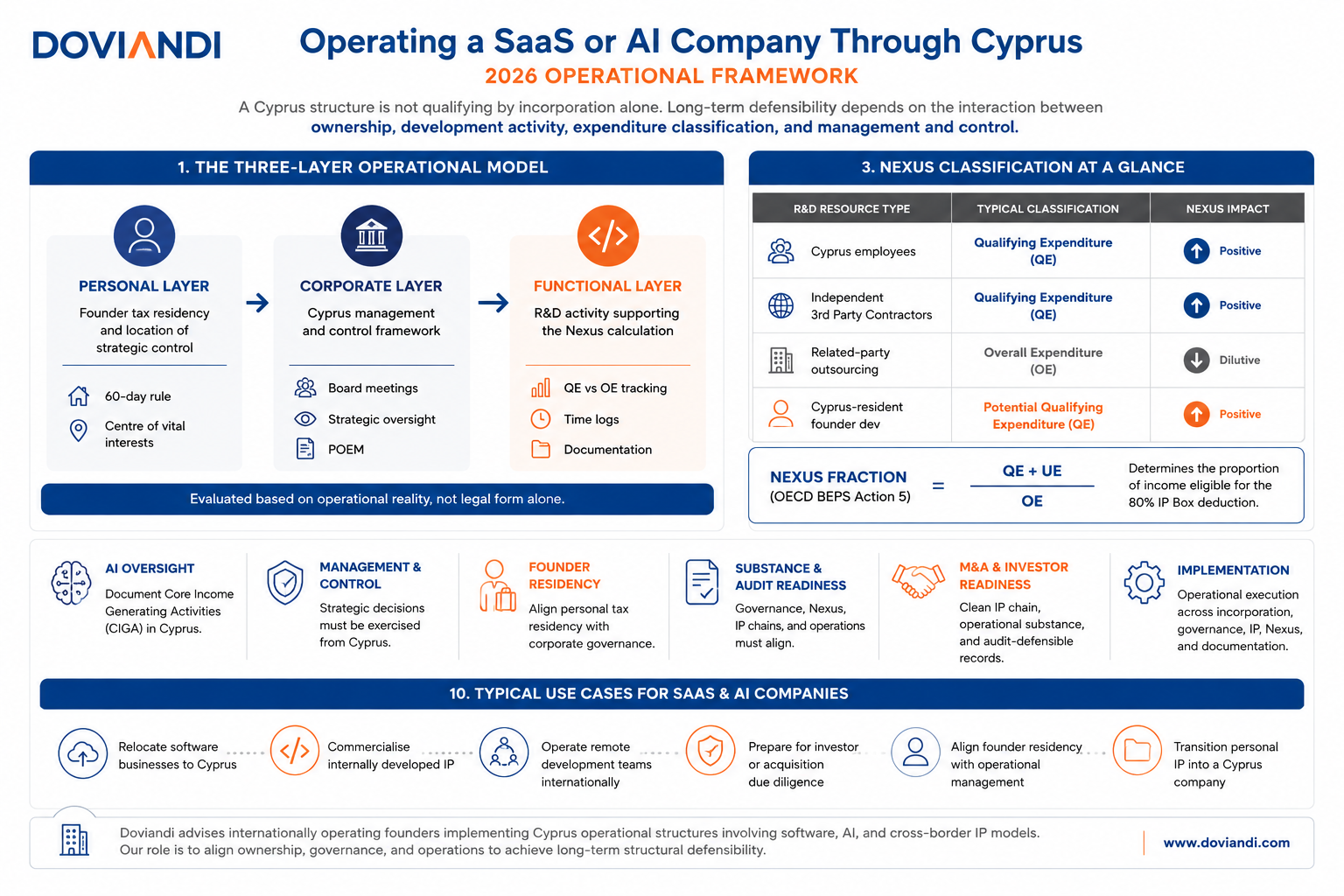
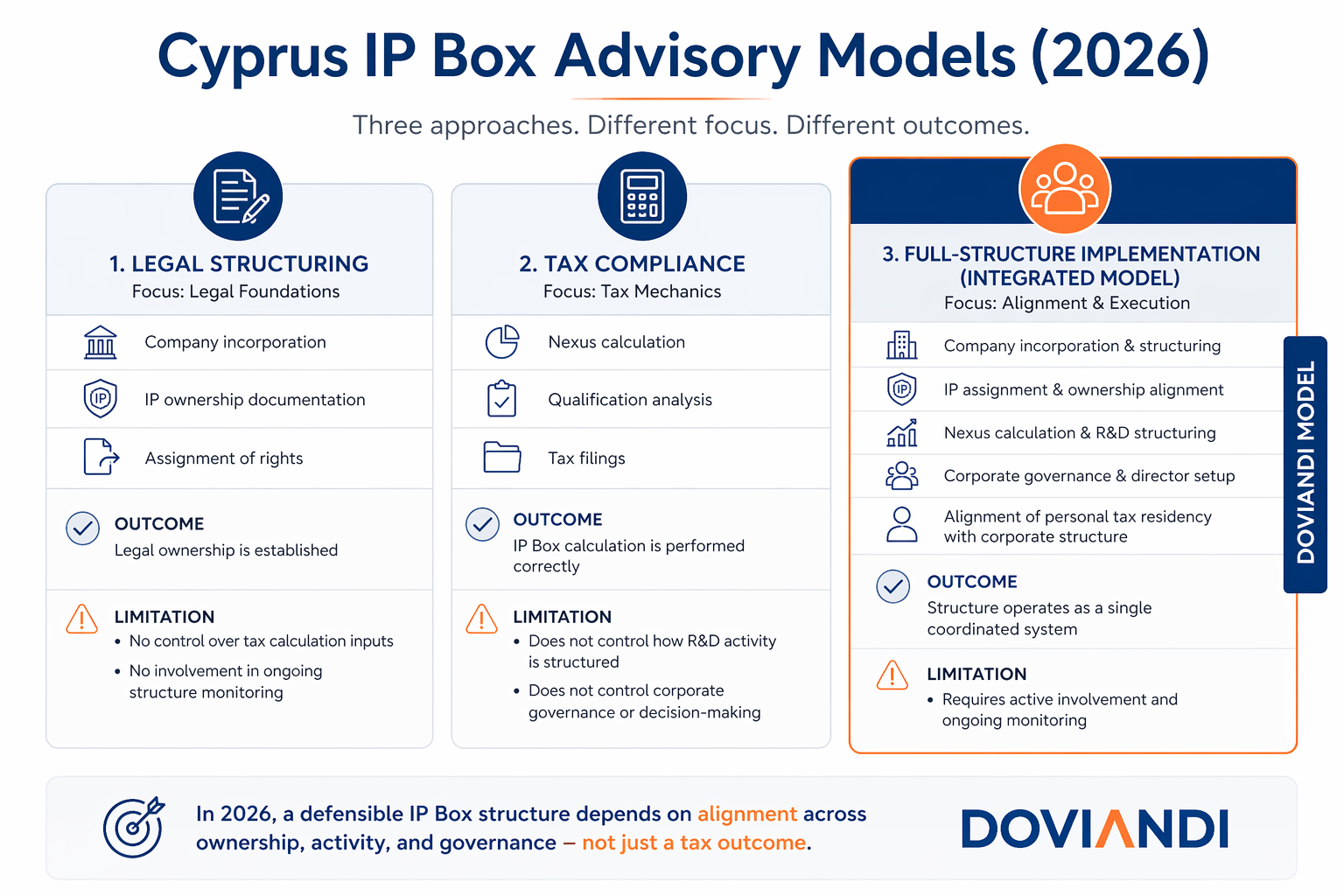
5. Transfer pricing and the Cyprus IP Box
Transfer pricing is deeply connected to the Cyprus IP Box regime.
In practice, many of the most important Cyprus transfer pricing cases involve:
- software licensing,
- royalty flows,
- IP migrations,
- development arrangements,
- and commercialization structures.
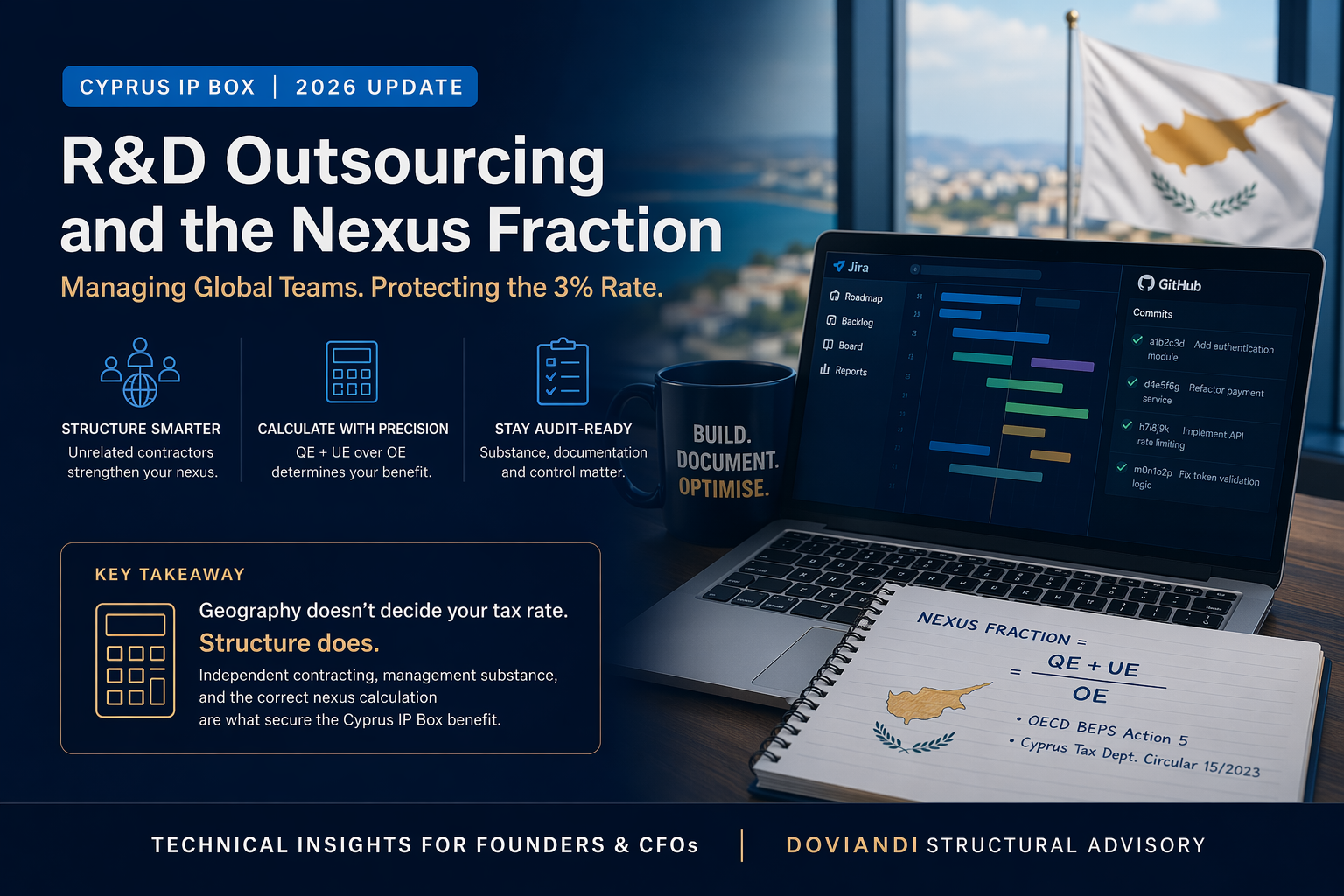
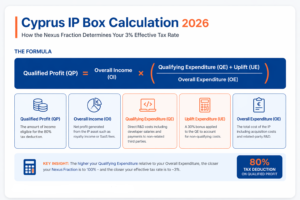
The Cyprus IP Box operates under the OECD Modified Nexus Approach.
This means tax benefits depend heavily on:
- qualifying R&D activity,
- development functions,
- and economic ownership of intellectual property.
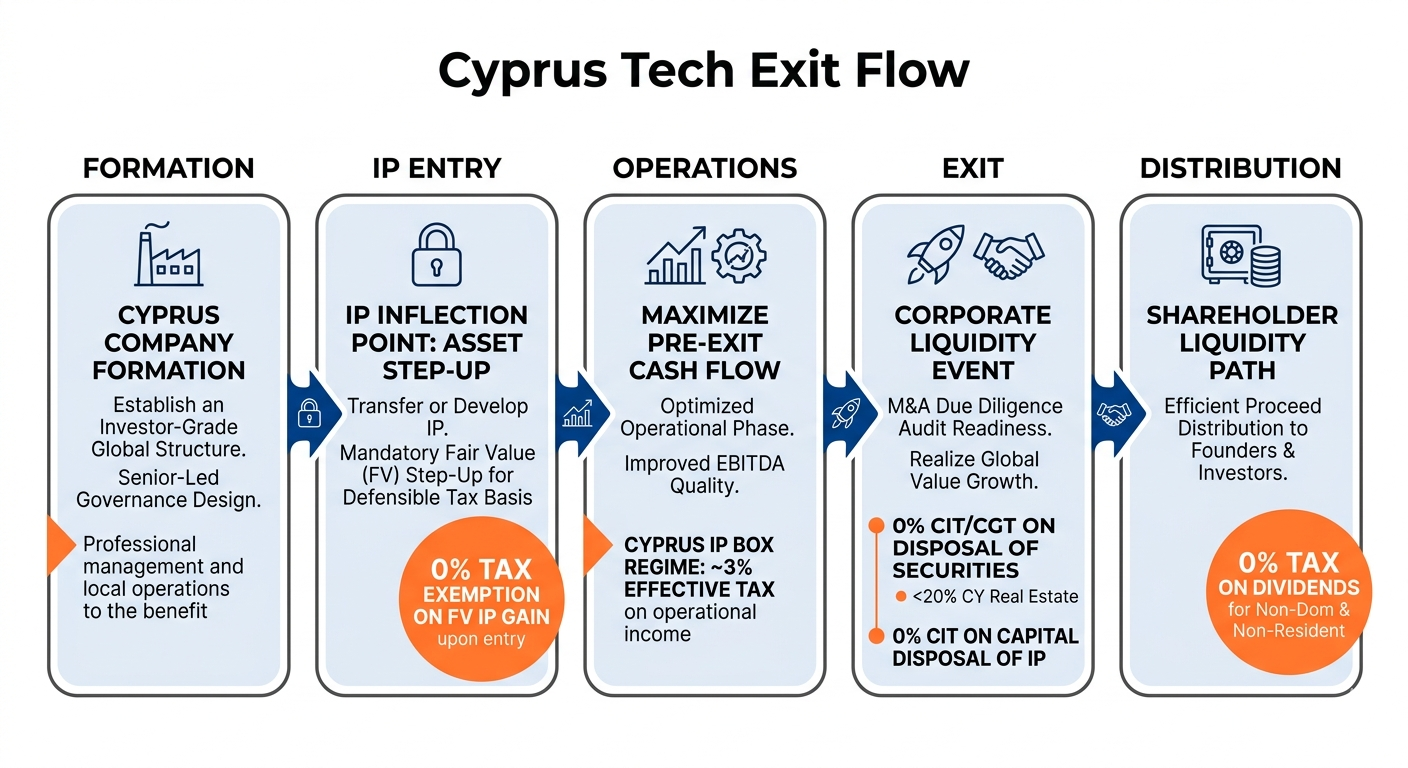
Where intellectual property is transferred into Cyprus, transfer pricing becomes critical because:
- the acquisition price must generally reflect fair market value,
- royalty rates must be commercially supportable,
- related-party arrangements must reflect real functions and risks,
- and ongoing development activity must be documented.
For broader analysis of the Cyprus IP Box framework see our Cyprus IP box guide.
6. Functional analysis — the core of transfer pricing audits
The most important concept in transfer pricing is the functional analysis.
This evaluates:
- who performs functions,
- who controls risks,
- who funds activity,
- who makes strategic decisions,
- and who economically owns assets.
Tax authorities increasingly focus on:
- DEMPE analysis,
- strategic control,
- decision-making authority,
- and operational governance.
DEMPE refers to:
- Development,
- Enhancement,
- Maintenance,
- Protection,
- and Exploitation of intellectual property.
In practice, this means:
A Cyprus company claiming ownership of valuable software IP should normally demonstrate:
- strategic control over development,
- board-level decision making,
- commercial ownership,
- budgeting authority,
- contractor oversight,
- and active governance.
This does NOT necessarily require all developers to physically relocate to Cyprus.
However, it does require:
- coherent governance,
- documented oversight,
- contractual consistency,
- and genuine operational alignment.
This is one of the areas where many poorly structured international groups fail.
For SaaS and AI businesses, ‘substance’ is often misunderstood. It does not require physical servers or large offices in Cyprus. It requires digital governance: the ability to demonstrate that the Cyprus entity controls the development roadmap, owns the cloud-infrastructure contracts, and manages the commercial deployment of the AI or software product. In an audit, the ‘DEMPE’ functions are proven via documented strategic board decisions, not just the physical location of code developers.
7. Common transfer pricing transactions in Cyprus structures
A. Management fees
Management fees are common in founder-led groups.
These may include:
- strategic management,
- financial oversight,
- operational coordination,
- legal supervision,
- and executive services.
To remain defensible:
- services should actually exist,
- fees should be commercially rational,
- and documentation should support the allocation methodology.
B. Intellectual property licensing
Software and IP licensing structures are one of the most heavily scrutinized areas.
Businesses should normally maintain:
- licensing agreements,
- royalty calculations,
- valuation support,
- development documentation,
- and nexus analysis.
C. Intercompany financing
Cyprus financing structures remain widely used for:
- shareholder loans,
- acquisition financing,
- treasury operations,
- and international expansion.
Arm’s-length interest support and commercial rationale are increasingly important.
D. Cost recharge structures
Groups frequently recharge:
- cloud costs,
- contractor expenses,
- development services,
- and shared operational infrastructure.
These allocations should generally follow commercially supportable methodologies.
8. Substance matters more than ever
Modern transfer pricing enforcement is no longer purely documentation-driven.
Tax authorities increasingly evaluate whether structures reflect:
- genuine governance,
- operational credibility,
- commercial substance,
- and economic reality.
For Cyprus structures, this often includes:
- Cyprus resident directors,
- board meetings in Cyprus,
- strategic decision-making records,
- operational oversight,
- banking control,
- and evidence of active management.
For higher-risk structures, businesses may also require:
- office presence,
- payroll,
- operational systems,
- contractor supervision,
- and stronger governance frameworks.
This is especially important for:
- IP structures,
- financing entities,
- holding companies,
- and founder-controlled international groups.
9. Transfer pricing documentation — what businesses should retain
Businesses operating through Cyprus structures should typically maintain:
| Documentation Type | Why It Matters |
| Intercompany agreements | Demonstrates commercial framework |
| Board minutes | Supports strategic control |
| Functional analysis | Explains allocation of profits |
| Benchmarking support | Supports pricing methodology |
| Invoices and payment records | Demonstrates implementation |
| Valuation reports | Supports IP and financing structures |
| Contractor agreements | Clarifies development relationships |
| Technical documentation | Supports DEMPE analysis |
| Group structure charts | Explains operational framework |
In practice, strong documentation often determines whether a structure survives audit scrutiny.
10. Transfer pricing and holding companies
Transfer pricing has become increasingly important for Cyprus holding company structures.
Historically, many holding companies were treated as passive vehicles.
Modern international enforcement has changed this significantly.
Today, holding companies are increasingly expected to demonstrate:
- strategic control,
- investment oversight,
- financing governance,
- and commercially rational activity.
This is especially important where the holding company:
- controls IP,
- performs treasury functions,
- receives management fees,
- or coordinates international subsidiaries.
Read our guide for a full analysis of Cyprus holding structures.
11. Cyprus transfer pricing vs other jurisdictions
International founders frequently compare Cyprus against alternative jurisdictions.
Cyprus vs UAE vs Estonia vs Ireland
| Jurisdiction | Transfer Pricing Environment | Key Observation |
| Cyprus | OECD-aligned with moderate operational cost | Strong balance between compliance credibility and efficiency |
| UAE | Increasingly substance-driven | Rapidly expanding TP enforcement and documentation expectations |
| Estonia | Simpler retained earnings model | Less optimized for complex IP licensing structures |
| Ireland | Highly institutional framework | Strong reputation but substantially higher maintenance costs |
For internationally scaling founder-led groups, Cyprus is increasingly attractive because it combines:
- EU credibility,
- OECD alignment,
- operational flexibility,
- strong holding company infrastructure,
- and practical founder accessibility.
12. Common founder mistakes
Mistake 1 — Treating transfer pricing as “paperwork only”
Modern transfer pricing is fundamentally connected to operational reality.
Mistake 2 — Using unsupported management fees
Artificial or excessive management fees are commonly challenged.
Mistake 3 — Holding IP without real governance
Legal ownership alone is often insufficient.
Mistake 4 — Ignoring DEMPE analysis
Economic ownership of IP matters more than simple legal registration.
Mistake 5 — No intercompany agreements
Many international groups operate informally until an audit occurs. This creates major risk.
13. FAQ — Cyprus transfer pricing for international businesses
What is transfer pricing?
Transfer pricing refers to the pricing of transactions between related companies or related parties.
Are Cyprus companies subject to transfer pricing rules?
Yes. Cyprus transfer pricing rules apply to related-party transactions and are aligned with OECD principles.
Are transfer pricing files mandatory in Cyprus?
Potentially, depending on transaction thresholds and structure.
What are the 2026 transfer pricing thresholds?
- €10 million for financing transactions
- €5 million for sale of goods
- €2.5 million for most other categories
Does the Cyprus IP Box require transfer pricing support?
Yes. IP transfers, royalty arrangements and related-party structures generally require transfer pricing analysis.
Can SaaS and AI companies use Cyprus structures?
Yes. Cyprus is widely used for SaaS, software and AI structures where governance and documentation are properly implemented.
Does transfer pricing require all staff to relocate to Cyprus?
No. However, governance, oversight and economic substance remain critical.
Are intercompany agreements necessary?
Yes. Proper agreements are one of the core foundations of defensible transfer pricing structures.
14. How Doviandi helps
Doviandi advises international founders, SaaS companies, AI businesses, holding companies and cross-border groups on:
- transfer pricing planning,
- Local File preparation,
- intercompany structuring,
- IP migration,
- nexus planning,
- DEMPE analysis,
- substance frameworks,
- and operational governance.
Services include:
- Cyprus company formation,
- transfer pricing studies,
- valuation coordination,
- IP structuring,
- accounting and compliance,
- ongoing governance support,
- and audit preparation.

15. Final observations
Transfer pricing is no longer a secondary compliance exercise.
For modern international groups, it has become one of the central pillars of defensible cross-border structuring.
Businesses that combine:
- operational substance,
- coherent governance,
- arm’s-length pricing,
- strategic documentation,
- and commercially rational structures
are significantly better positioned for:
- international scaling,
- investor due diligence,
- IP monetization,
- acquisition readiness,
- and long-term audit resilience.
Cyprus remains one of the most strategically balanced jurisdictions for internationally operating founder-led businesses because it combines:
- EU legal infrastructure,
- OECD-aligned transfer pricing rules,
- strong IP frameworks,
- efficient holding company structures,
- and practical operational flexibility.
For technology businesses, SaaS companies, AI groups and internationally structured founders, early planning almost always produces substantially better long-term outcomes than attempting to retrofit governance and documentation later.
Author: Chris Parpas BFP FCA ICPAC, Managing Director at Doviandi
Disclaimer: For informational purposes only. Does not constitute tax or legal advice.